Whistleblower Protections in Santa Ana After Corruption Cases

Facing retaliation for exposing workplace corruption remains one of the top reasons American public sector employees in Santa Ana hesitate to report unethical behavior. With local scandals fueling widespread concern, many workers feel unsure about their rights and the real reach of whistleblower protections. Understanding who the law shields and how recent reforms have shifted legal remedies gives you practical strategies to defend yourself and protect your career.
Table of Contents
- Defining Whistleblower Protections And Misconceptions
- California Laws Covering Santa Ana Employees
- Types Of Protected Disclosures And Procedures
- Retaliation Risks And Legal Remedies
- Recent Reforms After High-Profile Cases
- Practical Steps For Reporting Workplace Corruption
Key Takeaways
| Point | Details |
|---|---|
| Understanding Protections | Whistleblower protections safeguard employees reporting misconduct from retaliation in both public and private sectors. |
| California Law Advantages | California offers broader protections compared to federal standards, including strong remedies against employer retaliation. |
| Effective Reporting Procedures | Documenting evidence and using internal reporting channels are crucial initial steps before escalating to external authorities. |
| Retention of Records | Maintaining a detailed, dated record of all communications and evidence is essential for strengthening legal protection against retaliation. |
Defining Whistleblower Protections and Misconceptions
Whistleblower protections represent a critical legal framework designed to safeguard employees who report unethical, illegal, or dangerous practices within their organizations. These legal provisions ensure that workers who expose misconduct cannot be punished, demoted, or terminated for their transparency. In Santa Ana, where several high-profile corruption cases have emerged, understanding these protections becomes especially crucial.
The legal landscape of whistleblower rights is more nuanced than many employees realize. Whistleblower protections extend beyond simple reporting mechanisms, covering a range of disclosures that reveal potential violations of law, regulations, or significant public safety risks. Contrary to popular belief, these protections are not limited to government employees but also apply to private sector workers across various industries.
Misconceptions about whistleblower rights often prevent employees from speaking up. Many workers fear immediate retaliation or believe their reports must be perfect to qualify for legal protection. However, the law recognizes that good-faith reporting, even if not entirely precise, deserves defense. Whistleblowers are protected when they reasonably believe that the information demonstrates a violation, regardless of whether the subsequent investigation confirms every detail.
Pro tip: Document every interaction and communication related to your whistleblower report to create a clear, chronological record that can support your case if legal challenges arise.
California Laws Covering Santa Ana Employees
California provides robust legal protections for employees in Santa Ana through comprehensive whistleblower legislation that goes beyond federal standards. Detailed state regulations protect workers who report workplace violations, ensuring employees can speak up about unethical or illegal practices without fear of professional retaliation.
Under California Labor Code Section 1102.5, Santa Ana workers are shielded from adverse employment actions when they report potential legal violations. These protections cover a wide range of disclosures, including reporting unsafe working conditions, financial misconduct, environmental hazards, or violations of state and federal laws. The law applies to both public and private sector employees, creating a comprehensive shield against workplace retaliation.
The scope of protection is intentionally broad, recognizing that employees often face significant risks when exposing organizational misconduct. Workers are protected not only when reporting directly to government agencies but also when disclosing concerns internally to supervisors or human resources departments. This means an employee who raises concerns about potential illegal activities within their organization cannot be terminated, demoted, suspended, or subjected to any form of professional punishment as a result of their good-faith reporting.
Pro tip: Keep detailed, dated records of all communications related to your workplace disclosure, including emails, witness statements, and documentation of the reported misconduct to strengthen your legal protection.
Here’s a comparison of whistleblower protections for Santa Ana employees under California law versus federal standards:
| Area of Protection | California Law (Santa Ana) | Federal Standards | Impact for Employees |
|---|---|---|---|
| Coverage Scope | Public and private sectors | Often limited | Broader protection |
| Retaliation Remedies | Reinstatement, back pay, punitive damages | Limited remedies | Stronger legal recourse |
| Reporting Channels | Internal and external | Primarily external | Multiple avenues to report |
| Burden of Proof | Presumed retaliation if close in time | Higher burden | Easier for employees |
Types of Protected Disclosures and Procedures
Whistleblower protections in California cover a comprehensive range of disclosures designed to safeguard employees who expose potential misconduct. Legal procedures for reporting workplace violations offer multiple channels for employees to raise concerns, ensuring workers can choose the most appropriate method for their specific situation.
The primary types of protected disclosures include reporting violations to external government agencies, internal reporting to supervisors or human resources departments, and refusing to participate in activities that would violate state or federal laws. Employees are legally protected when disclosing information about unsafe working conditions, financial fraud, environmental hazards, regulatory violations, and other forms of organizational misconduct. These protections extend to both verbal and written communications, including emails, formal reports, and informal conversations with appropriate authorities.
Critical to understanding these protections is recognizing the specific procedures for making protected disclosures. Employees should typically start by documenting the alleged misconduct in detail, including dates, specific incidents, and any supporting evidence. While internal reporting is often the first step, workers have the right to escalate concerns to external agencies if they believe internal channels are ineffective or potentially compromised. This multi-tiered approach ensures that employees have multiple avenues to report potential violations without fear of professional retaliation.
Pro tip: Maintain a contemporaneous, detailed written record of all communications related to your disclosure, including dates, names, and specific details of the reported misconduct to strengthen your legal protection and credibility.
Retaliation Risks and Legal Remedies
Whistleblowers in Santa Ana face numerous potential risks when exposing workplace misconduct, ranging from subtle professional obstacles to outright termination. Legal remedies provide comprehensive protections against various forms of employer retaliation, ensuring workers can speak up without fear of professional consequences.

Retaliation can manifest in multiple ways, including wrongful termination, demotion, salary reduction, harassment, negative performance evaluations, schedule changes, or creating a hostile work environment. California law recognizes these tactics as illegal and provides robust mechanisms for employees to challenge such actions. Workers who experience retaliation can file administrative complaints with state agencies, pursue civil litigation, and seek remedies that may include reinstatement, back pay, compensation for emotional distress, and punitive damages against the offending employer.
The legal process for addressing retaliation requires careful documentation and strategic action. Employees must typically demonstrate that their protected disclosure was a substantial motivating factor in the adverse employment action. This means collecting evidence such as performance records, communication logs, witness statements, and a clear timeline of events showing the connection between the whistleblowing activity and subsequent professional consequences. Courts and administrative bodies will closely examine the temporal proximity between the disclosure and the retaliatory action to determine the validity of the claim.
Pro tip: Preserve all communication records, including emails, text messages, and performance documents, and create a detailed, chronological journal documenting every instance of potential retaliation to strengthen your legal case.
Recent Reforms After High-Profile Cases
Santa Ana’s legal landscape has undergone significant transformation in response to several landmark corruption cases that exposed systemic workplace misconduct. Recent legislative reforms have dramatically expanded whistleblower protections, creating more robust mechanisms for employees to report unethical practices without fear of professional retaliation.
Key legislative changes include expanded definitions of protected disclosures, stronger penalties for employers who engage in retaliatory actions, and more comprehensive coverage for both public and private sector employees. These reforms specifically address previous legal gaps that allowed organizations to circumvent accountability. Now, employers face more stringent reporting requirements, mandatory training on whistleblower rights, and increased financial penalties for violations. The reforms also provide additional layers of protection for employees who make good-faith disclosures, ensuring that even if an investigation does not ultimately substantiate every detail of the original complaint, the whistleblower remains legally protected.
The most significant changes stem from high-profile cases involving municipal corruption, financial fraud, and workplace safety violations in Orange County. These reforms now require more transparent internal reporting mechanisms, create additional avenues for external reporting, and shift the burden of proof in retaliation cases. Courts are now more likely to presume that adverse employment actions are retaliatory if they occur shortly after a protected disclosure, effectively strengthening the legal position of whistleblowers in Santa Ana and throughout California.
Pro tip: Stay informed about the latest legislative updates by subscribing to local employment law newsletters and attending free legal workshops that explain recent changes in whistleblower protection regulations.
Practical Steps for Reporting Workplace Corruption
Reporting workplace corruption requires a strategic and careful approach to protect your professional interests and legal rights. The California State Auditor’s official procedures provide a comprehensive framework for safely documenting and reporting improper activities, ensuring employees can expose misconduct with minimal personal risk.
The reporting process involves several critical steps: First, thoroughly document all evidence of misconduct, including dates, specific incidents, and any supporting documentation like emails, financial records, or witness statements. Employees should first attempt internal reporting through established channels such as human resources or compliance departments, creating a formal written record of their disclosure. If internal mechanisms seem ineffective or potentially compromised, workers can escalate their concerns to external agencies like the California State Auditor, the Labor Commissioner’s Office, or other relevant regulatory bodies depending on the nature of the violation.
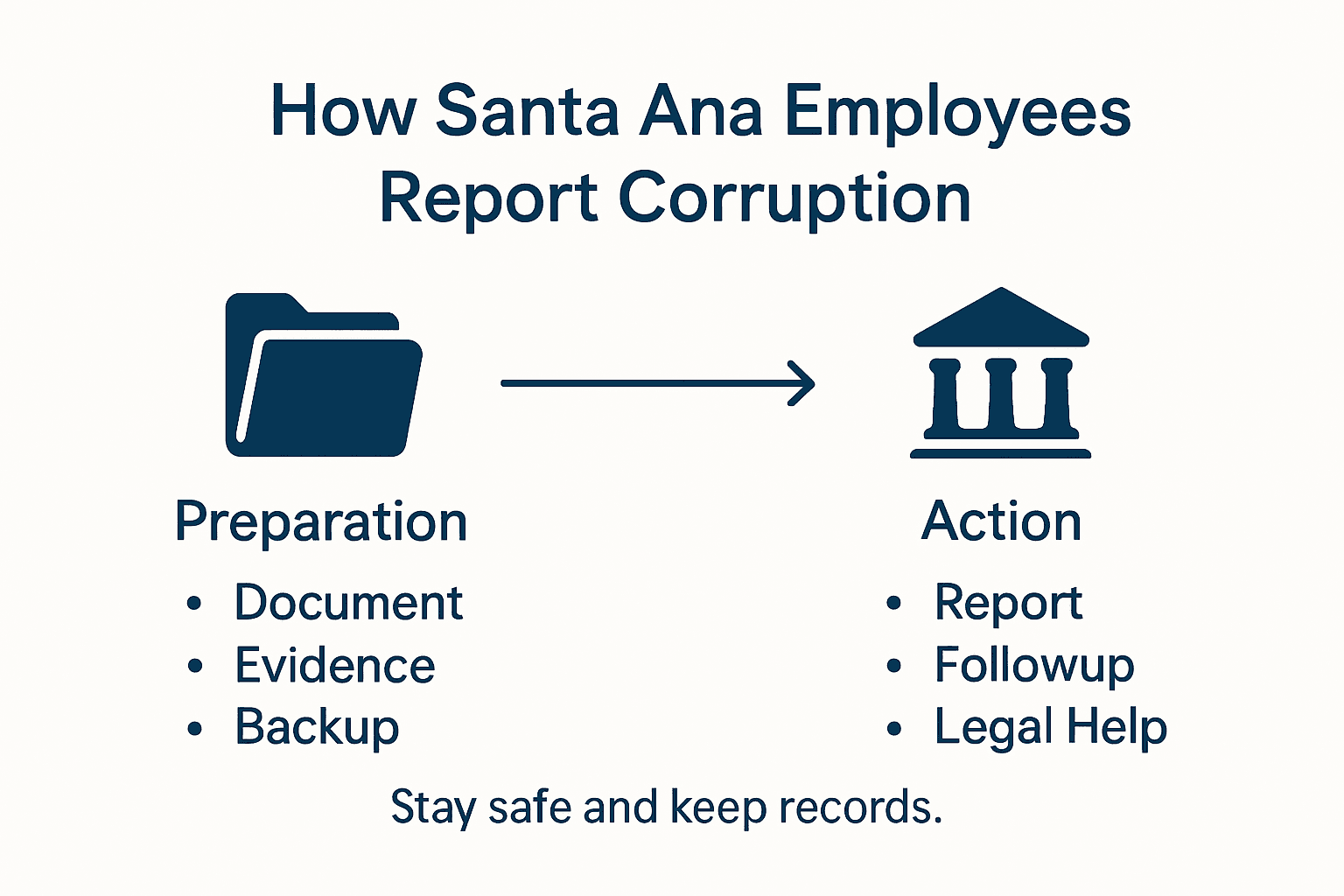
Professional documentation is crucial when reporting workplace corruption. Employees should maintain a detailed, contemporaneous journal of events, preserve all relevant communications, and avoid confrontational or inflammatory language. It is essential to focus on objective facts and specific instances of misconduct rather than personal grievances. Workers should also be prepared for potential challenges, understanding that while legal protections exist, the reporting process can be complex and may require patience and persistent documentation of any potential retaliatory actions.
Pro tip: Create a secure, digital and physical backup of all documentation related to your corruption report, storing copies in multiple locations to ensure evidence preservation and protect against potential tampering.
This table summarizes key steps and potential challenges when reporting workplace corruption:
| Step | Action Required | Common Challenge | Best Practice |
|---|---|---|---|
| Evidence Documentation | Collect emails, records, logs | Incomplete details | Keep thorough, dated records |
| Internal Reporting | Inform HR or supervisor | Fear of retaliation | Stay objective and factual |
| External Reporting | Contact agencies | Navigating procedures | Consult legal experts |
| Record Preservation | Back up communication files | Loss or tampering | Use secure, multiple backups |
Protect Your Rights as a Whistleblower in Santa Ana
If you have faced retaliation after reporting workplace corruption or unethical practices you are not alone and you do not have to face this challenge without support. This article highlights key protections under California law designed to shield whistleblowers from adverse actions such as wrongful termination, demotion, or harassment. Understanding your rights and keeping detailed documentation can make all the difference when confronting retaliation.
At Serendib Law Firm, we specialize in helping employees in Santa Ana navigate complex whistleblower retaliation cases with personalized and dedicated legal representation. Whether you need guidance on preserving evidence or want to understand your legal remedies, our experienced attorneys are ready to fight for your protection. Visit our Whistleblower Retaliation Archives | Serendib Law Firm to learn more about your rights, or explore broader protections in our Retaliation Archives | Serendib Law Firm.
Do not wait until retaliation costs you your career. Take control of your situation now by contacting us at Serendib Law Firm for a free consultation. Protect your voice and your future today.
Frequently Asked Questions
What are whistleblower protections?
Whistleblower protections are legal safeguards designed to protect employees who report unethical, illegal, or dangerous practices within their organizations from retaliation, such as termination or demotion.
What types of disclosures are protected under California law?
California law protects disclosures related to unsafe working conditions, financial misconduct, environmental hazards, and violations of state and federal laws, whether reported internally or to external agencies.
How can I report workplace corruption safely?
To report workplace corruption safely, start by documenting all evidence of misconduct in detail and then report it through internal channels like HR. If internal reporting seems ineffective, you can escalate your concerns to external regulatory agencies.
What are the legal remedies available if I face retaliation for whistleblowing?
If you experience retaliation after making a protected disclosure, you may have legal options, including filing administrative complaints or pursuing civil litigation for remedies such as reinstatement, back pay, and compensation for emotional distress.
Recommended
- Whistleblower Protection | Serendib Law Firm
- Whistleblower Protection | Serendib Law Firm
- Whistleblower Protection | Serendib Law Firm
- Santa Ana Whistleblower Retaliation in Clinics Guide | Serendib Law Firm
- Employment Law – Law Office of Brian Y. Shirazi, PC
https://www.serendiblaw.com/whistleblower-protections-santa-ana/?fsp_sid=389


Comments
Post a Comment