Overlapping Leave Requests: Understanding CFRA vs. FMLA

CFRA and FMLA might sound like just another pair of confusing workplace acronyms, but these laws touch almost every working family in California. You might think federal leave laws cover it all, yet in California CFRA lets employees at businesses with as few as five workers claim job-protected leave, far beyond the federal rules. That surprise twist means more Californians have powerful legal rights most folks never realize even exist.
Table of Contents
- Defining Cfra And Fmla: Key Differences And Similarities
- The Importance Of Employee Protections Under Both Acts
- Protecting Workers During Critical Life Events
- Economic And Psychological Impact Of Leave Protections
- How Cfra And Fmla Interact During Overlapping Leave Requests
- Real-World Implications Of Cfra Vs. Fmla For Employees
- Navigating Conflicts: Rights And Responsibilities In Leave Requests
Quick Summary
| Takeaway | Explanation |
|---|---|
| CFRA covers more employers than FMLA. | CFRA applies to businesses with at least five employees, while FMLA applies to those with 50 or more, expanding coverage. |
| CFRA allows broader family leave definitions. | Under CFRA, more family members are eligible for care leave compared to FMLA, enhancing worker protections in California. |
| Concurrent leave use enhances total available leave. | Employees can use CFRA and FMLA simultaneously, but cannot exceed the maximum leave duration both laws allow. |
| Documentation is vital for leave requests. | Employees must provide detailed medical certifications and follow procedural guidelines to ensure their leave is properly handled. |
| Employers must maintain confidentiality and compliance. | Employers are obligated to protect employee medical information and evaluate leave requests in a consistent, unbiased manner. |
Defining CFRA and FMLA: Key Differences and Similarities
The California Family Rights Act (CFRA) and the Family and Medical Leave Act (FMLA) are two critical federal and state employment protection laws designed to provide workers with job-protected leave for specific personal and family medical situations. While these laws share fundamental similarities, they also possess distinct characteristics that can significantly impact an employee’s leave rights.
Understanding Federal and State Leave Protections
The FMLA is a federal statute established in 1993 that provides eligible employees with up to 12 weeks of unpaid, job-protected leave annually for specific family and medical reasons. Learn more about FMLA and CFRA leave to understand your workplace rights comprehensively.
Key situations covered under FMLA include:
- Birth and care of a newborn child
- Adoption or foster care placement
- Caring for an immediate family member with a serious health condition
- Employee’s own serious health condition preventing work performance
Comparing CFRA and FMLA Provisions
While FMLA is a federal law applicable nationwide, CFRA is California’s state-specific legislation that often provides broader protections for workers. The primary differences emerge in several critical areas
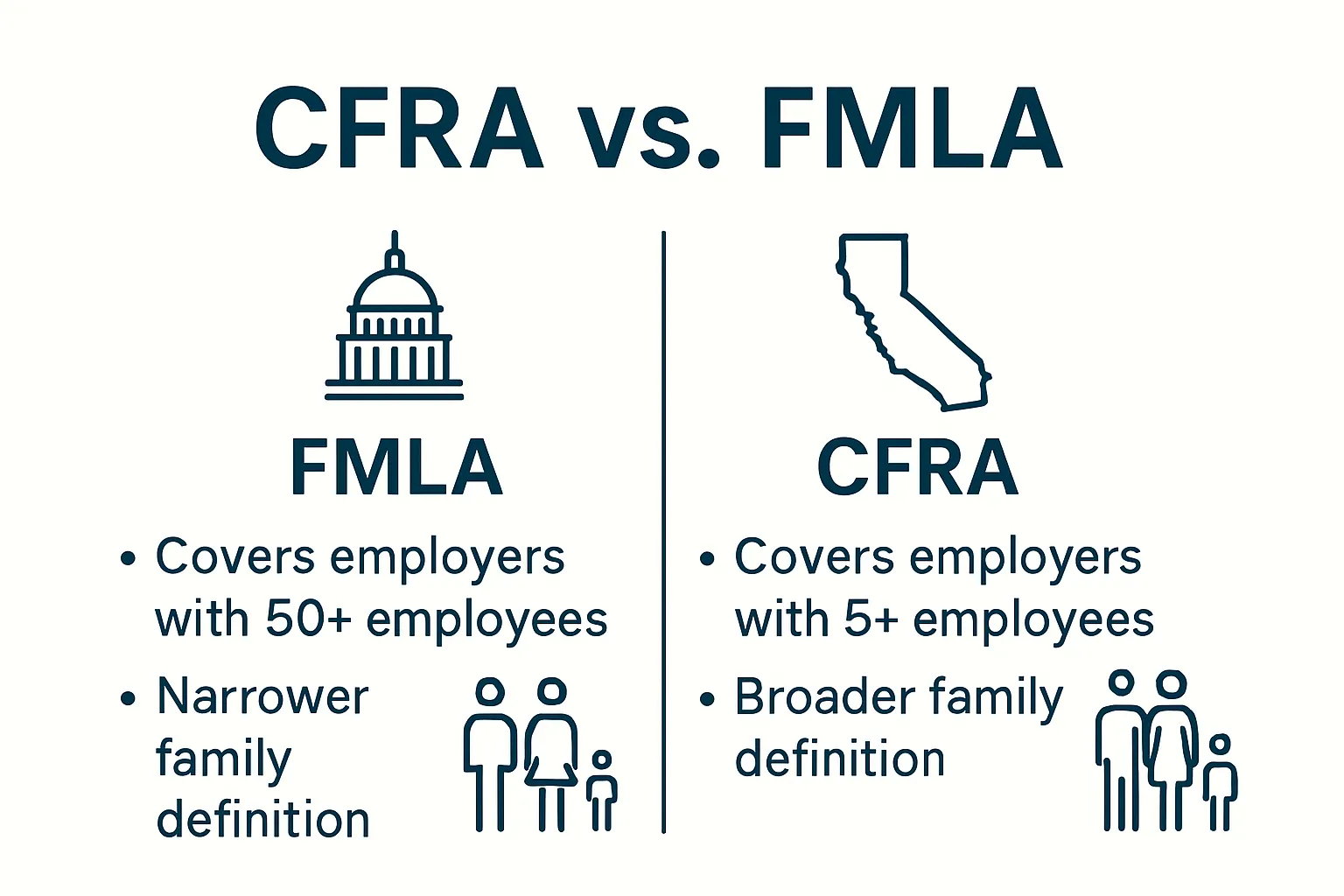 :
:
- Covered Employers: FMLA applies to companies with 50 or more employees, whereas CFRA covers employers with five or more workers
- Family Member Definitions: CFRA has a more expansive definition of family members eligible for care
- Medical Conditions: CFRA offers more inclusive provisions for medical leave scenarios
Under CFRA, California employees receive enhanced protections that sometimes exceed federal FMLA standards. For instance, CFRA provides more comprehensive leave options for employees caring for domestic partners, registered same-sex spouses, and broader categories of family members compared to federal guidelines.
Critically, when CFRA and FMLA leave requests overlap, employees can potentially utilize both laws concurrently, maximizing their job-protected leave opportunities.
To help clarify the scope and application of each law, the table below compares key features of CFRA and FMLA side by side.
| Feature | CFRA (California Family Rights Act) | FMLA (Family and Medical Leave Act) |
|---|---|---|
| Covered Employers | Businesses with 5 or more employees | Businesses with 50 or more employees |
| Eligible Family Members for Leave | Includes broader definitions: domestic partners, registered same-sex spouses, more family members | Limited to spouse, parent, child |
| Qualifying Medical Conditions | More inclusive for certain medical situations | Federal standard; sometimes narrower |
| Job Protection | Yes | Yes |
| Health Insurance Continuity | Required | Required |
| Leave Duration | Up to 12 weeks in 12 months (often concurrent with FMLA) | Up to 12 weeks in 12 months (often concurrent with CFRA) |
| Geographic Coverage | California employees | Nationwide (all U.S. states) |
This nuanced interaction between state and federal regulations underscores the importance of understanding your specific workplace rights and protections.
The Importance of Employee Protections Under Both Acts
Employee protections provided by CFRA and FMLA represent critical legal safeguards that ensure workers can address significant personal and family medical circumstances without fear of professional repercussions. Our experienced Orange employment law attorneys understand how these complex regulations protect worker rights and provide essential support during challenging life moments.
Protecting Workers During Critical Life Events
Both CFRA and FMLA recognize that employees sometimes face extraordinary personal circumstances requiring time away from work. These laws acknowledge that workers should not be penalized for addressing serious medical conditions, welcoming new children, or caring for critically ill family members. The protections extend beyond mere job security, encompassing fundamental human dignity and workplace compassion.
Key protections under these acts include:
- Guaranteed job restoration after leave
- Continued health insurance coverage
- Protection against workplace discrimination
- Preservation of professional standing and career trajectory
Economic and Psychological Impact of Leave Protections
The psychological relief provided by CFRA and FMLA cannot be overstated. Workers facing potentially devastating personal circumstances can focus on health recovery or family care without constant anxiety about potential job loss. These laws recognize that employees are more than just workers they are human beings with complex lives and responsibilities.
Statistically, robust leave protection laws contribute to:
- Increased workforce retention
- Improved employee mental health
- Enhanced workplace loyalty
- Reduced financial stress during medical emergencies
Under research from the Department of Labor, comprehensive leave protection laws like CFRA and FMLA demonstrate significant societal benefits. By mandating job-protected leave, these regulations help maintain economic stability for individual workers while supporting broader public health objectives. The intricate balance between employee rights and employer needs reflects a nuanced approach to modern workplace management, acknowledging that supportive policies benefit both workers and organizations.
How CFRA and FMLA Interact During Overlapping Leave Requests
The interaction between California Family Rights Act (CFRA) and Family and Medical Leave Act (FMLA) creates a complex legal landscape for employees seeking job-protected leave. Understanding how these laws intersect is crucial for workers navigating challenging personal and medical circumstances. Learn more about workplace disability protections to comprehend the full scope of employee rights.
Concurrent Leave Provisions
When CFRA and FMLA leave requests overlap, employees can potentially utilize both laws simultaneously, effectively extending their total available protected leave. The key principle is that while these laws are separate, they can complement each other in specific scenarios. Critically, the laws cannot be used to extend the total leave duration beyond what is originally permitted.
Specific scenarios where concurrent leave might apply include:
- Serious health conditions affecting the employee
- Caring for an immediate family member with a medical condition
- Pregnancy-related medical leave
- Bonding time with a newborn or newly adopted child
Nuanced Legal Interactions
The interaction between CFRA and FMLA is not always straightforward. Certain conditions trigger different protections, and employees must carefully navigate these legal provisions. According to California Department of Fair Employment and Housing, the primary considerations include:
- Determining the specific type of leave being requested
- Verifying employee eligibility under both state and federal guidelines
- Understanding the precise definitions of qualifying medical conditions
- Assessing the impact on existing employment benefits
One critical distinction is how these laws treat different types of medical conditions. CFRA often provides more expansive protections for California workers, particularly in cases involving broader family definitions and more inclusive medical scenarios.
Employers must carefully analyze each leave request, considering the specific provisions of both CFRA and FMLA. The goal is to provide maximum protection for employees while maintaining reasonable operational considerations for businesses. This delicate balance ensures that workers can address critical personal and medical needs without undue professional risk.
Real-World Implications of CFRA vs. FMLA for Employees
The practical application of CFRA and FMLA extends far beyond legal technicalities, directly impacting employees’ lives during critical personal and medical circumstances. Our experienced Orange employment law attorneys understand the nuanced ways these protections manifest in real-world scenarios.
Navigating Personal Health Challenges
Employees confronting serious medical conditions face significant emotional and financial stress. CFRA and FMLA provide crucial support mechanisms that transform potential professional catastrophes into manageable life transitions. These laws ensure that workers can prioritize personal health without sacrificing career stability.
Real-world scenarios demonstrating legal protections include:
- Cancer treatment requiring extended medical leave
- Recovery from major surgical procedures
- Managing chronic health conditions
- Addressing mental health treatment needs
- Rehabilitating from workplace or personal injuries
Protecting Family Care Responsibilities
Beyond individual health scenarios, these laws recognize the complex familial responsibilities modern workers navigate. According to research from the Department of Labor, family caregiving represents a significant workforce consideration that requires legal protection.
Complex family care situations covered include:
- Caring for critically ill parents or spouse
- Supporting children with serious medical conditions
- Addressing elder care requirements
- Managing complex family medical emergencies
- Supporting family members through long-term treatments
The intersection of CFRA and FMLA creates a robust safety net that acknowledges employees are multifaceted individuals with responsibilities extending beyond workplace productivity.
Below is a summary of typical personal and family health scenarios highlighting how CFRA and FMLA protections apply in real-world situations.
| Scenario | How CFRA/FMLA Protect Employees |
|---|---|
| Cancer treatment for employee | Job-protected leave for duration of recovery |
| Caring for a newborn or adopted child | Leave for bonding time, with job protection |
| Supporting a spouse or domestic partner with illness | Broader eligibility under CFRA for family care |
| Managing chronic or serious health conditions | Eligible for intermittent or extended leave |
| Caring for elderly parent | Covered under both CFRA and FMLA |
| Addressing mental health treatment | Protected under appropriate medical certification |
| Domestic partner care | Explicitly covered under CFRA |
 By mandating job-protected leave and ensuring continued health benefits, these laws provide critical psychological and economic security during life’s most challenging moments.
Employees must proactively understand their rights, communicate clearly with employers, and document medical needs thoroughly. The legal protections are comprehensive, but successful navigation requires strategic personal advocacy and precise documentation of medical and family care requirements.
Navigating Conflicts: Rights and Responsibilities in Leave Requests
The complex landscape of CFRA and FMLA requires employees and employers to carefully balance legal obligations with practical workplace considerations. Our experienced Orange employment law attorneys emphasize the critical importance of understanding both individual rights and organizational responsibilities during leave request processes.
Employee Documentation Requirements
Successful leave requests demand meticulous documentation and proactive communication. Employees must provide comprehensive medical certification and adhere to specific procedural guidelines to ensure their leave requests are properly evaluated and processed.
Critical documentation elements include:
- Detailed medical certifications from healthcare providers
- Precise descriptions of medical conditions or family care needs
- Estimated duration of required leave
- Potential intermittent leave requirements
- Contact information for medical verification
Employer Compliance and Procedural Obligations
Employers bear significant legal responsibilities in managing leave requests. According to California Department of Fair Employment and Housing, organizations must implement consistent, transparent processes that protect both employee rights and organizational operational needs.
Key employer responsibilities encompass:
- Providing clear written communication about leave policies
- Maintaining confidentiality of medical information
- Evaluating leave requests objectively and consistently
- Preventing retaliation against employees requesting protected leave
- Preserving job positions or equivalent roles during leave periods
The intricate dance between employee rights and employer obligations requires mutual understanding and good-faith efforts. Miscommunication or intentional obstruction can lead to potential legal challenges, making transparency and clear documentation paramount.
Employees facing resistance or potential discrimination during leave requests should document all interactions carefully and consider seeking professional legal guidance. The nuanced protections offered by CFRA and FMLA represent critical safeguards against workplace inequities, ensuring workers can address personal and family medical needs without compromising professional standing.
Facing the Stress of Overlapping Leave Requests? Protect Your Rights with Expert Guidance
Understanding the difference between CFRA and FMLA is not just about knowing the law. It is about protecting your job, your health, and your future when personal or family crises strike. If you feel overwhelmed by documentation rules, fear retaliation from your employer, or simply do not know how to navigate your rights under CFRA and FMLA, you are not alone. Many California workers find themselves confused and anxious in these moments, struggling to balance medical needs with career stability. Our team is here to turn uncertainty into confidence.
For practical answers, visit our CA Employment Law section to see how these laws could affect your unique situation. Ready to take action? Do not let confusion or fear lead to mistakes that put your livelihood at risk. Connect with our compassionate attorneys now at Serendib Law Firm. Our proven experience with overlapping leave laws can help you protect what matters most.
Frequently Asked Questions
What are the main differences between CFRA and FMLA?
CFRA (California Family Rights Act) provides broader protections than FMLA (Family and Medical Leave Act), including coverage for employers with as few as five employees, and an expanded definition of family members eligible for care.
Can I use CFRA and FMLA leave concurrently?
Yes, when CFRA and FMLA leave requests overlap, employees can utilize both laws simultaneously, but the total leave duration cannot exceed the 12 weeks allowed under FMLA.
What types of medical conditions are covered under CFRA and FMLA?
Both CFRA and FMLA cover serious health conditions, including long-term illnesses, recovery from major surgeries, and care for a family member facing significant health issues. CFRA may offer more inclusive definitions of qualifying conditions.
What documentation do I need to request leave under CFRA and FMLA?
Employees must provide comprehensive medical certifications from healthcare providers detailing their medical conditions, estimated duration of leave, and, if applicable, any plans for intermittent leave.
Recommended
- FMLA / CFRA Leave | Serendib Law Firm
- Experienced Orange Employment Law Attorneys
- Pregnancy Leave | Serendib Law Firm
- Pregnancy Leave | Serendib Law Firm
https://www.serendiblaw.com/overlapping-leave-requests/?fsp_sid=12


Comments
Post a Comment