Understanding Arbitration Agreements and Their Impact on Sexual Harassment Claims

Arbitration agreements have quietly changed how millions of workers handle disputes on the job. Most people expect a day in court if something goes wrong, but about 60 million U.S. employees are already required to use private arbitration instead of suing their employer. This hidden agreement does not just make things faster, it often means your case will never see the light of a courtroom and the outcome could remain secret forever.
Table of Contents
- What Are Arbitration Agreements?
- The Significance of Arbitration in Workplace Disputes
- How Arbitration Agreements Affect Sexual Harassment Claims
- Key Concepts of Arbitration Agreements
- Real-World Examples and Context of Arbitration Impact
Quick Summary
| Takeaway | Explanation |
|---|---|
| Arbitration agreements limit legal options | Employees waive their rights to sue in court, opting for private arbitration instead. |
| Confidentiality can obscure misconduct | Arbitration agreements often include confidentiality, hiding workplace harassment information from public scrutiny. |
| Employers exhibit power through arbitration | These agreements typically favor employers, making it harder for employees to seek comprehensive justice. |
| Arbitration can be faster but less transparent | While it allows quicker resolutions, arbitration lacks the transparency and precedents of court trials. |
| Legislation is evolving on arbitration issues | Recent laws are addressing the enforceability of arbitration agreements, particularly in sexual harassment claims. |
What Are Arbitration Agreements?
Arbitration agreements represent legal contracts that fundamentally change how workplace disputes are resolved, shifting away from traditional court litigation. These agreements require employees to resolve conflicts through private arbitration instead of pursuing legal action in public court systems. When an employee signs such an agreement, they essentially waive their right to file a lawsuit and agree to have their dispute heard by a neutral third-party arbitrator.
The Basic Structure of Arbitration Agreements
Typically, arbitration agreements include specific provisions that outline how disputes will be handled. Key elements usually involve:
- Mandatory private dispute resolution
- Selection process for choosing an arbitrator
- Rules governing the arbitration procedure
- Limitations on potential financial recoveries
- Confidentiality requirements
Employers often include these agreements in employment contracts, employee handbooks, or as separate documents that workers must sign as a condition of employment. According to Cornell Law School’s analysis of employment contracts, these agreements can significantly impact an employee’s legal rights and potential remedies.
How Arbitration Differs from Traditional Litigation
Unlike court proceedings, arbitration is a private process where disputes are resolved outside public judicial systems. The process typically involves:
- A single arbitrator or panel making final binding decisions
- More streamlined procedures compared to court trials
- Typically faster resolution times
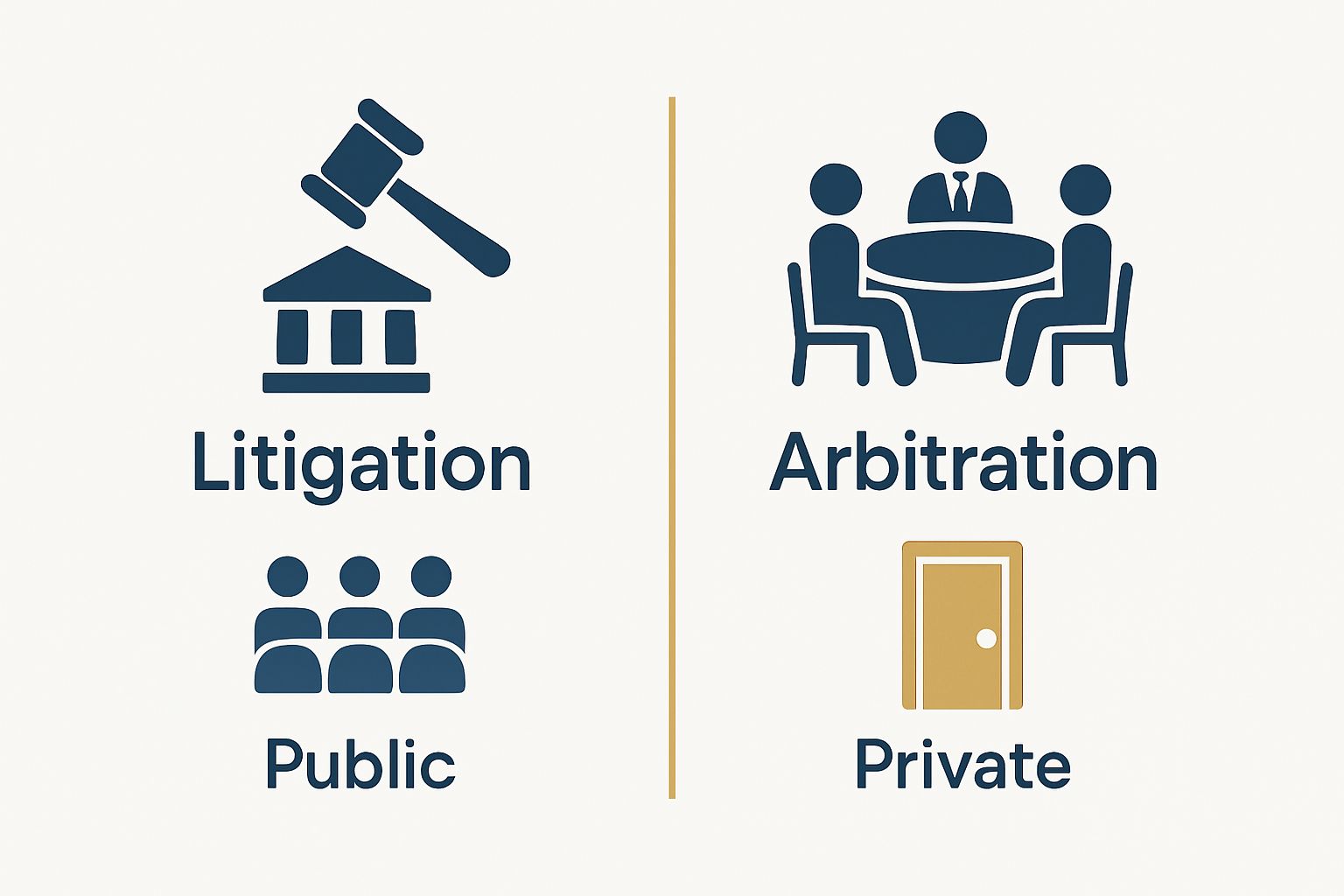
- Limited opportunities for appeal
Our comprehensive guide on employment law arbitration provides additional insights into how these agreements function in workplace settings. While arbitration can offer efficiency, critics argue that these agreements often favor employers by reducing employees’ ability to seek full legal recourse, particularly in sensitive cases like sexual harassment claims.
To clarify the differences between arbitration and traditional litigation in workplace disputes, the following table compares their main features and procedures.
| Feature | Arbitration | Traditional Litigation |
|---|---|---|
| Setting | Private | Public (courtroom) |
| Decision Maker | Arbitrator (neutral third party) | Judge and/or jury |
| Confidentiality | High (often required) | Low (court records are public) |
| Procedure Formality | Less formal | Highly formal |
| Resolution Speed | Typically faster | Often slower |
| Opportunity for Appeal | Very limited | Broader right to appeal |
| Precedent Setting | No legal precedent created | Can create binding legal precedent |
| Legal Remedies | Often limited by agreement | Full range available by law |
The Significance of Arbitration in Workplace Disputes
Arbitration has become a critical mechanism for resolving workplace conflicts, fundamentally transforming how employment disputes are addressed. Unlike traditional litigation, arbitration offers a more private, potentially expedited approach to conflict resolution that can benefit both employers and employees in specific circumstances.
Economic and Procedural Implications
The economic landscape of workplace dispute resolution is dramatically influenced by arbitration agreements. Employers frequently view these mechanisms as a cost-effective alternative to prolonged court battles. Arbitration typically involves lower legal expenses, reduced administrative costs, and faster resolution timelines. According to research from the American Arbitration Association, companies can save substantial resources by implementing structured arbitration processes.
Key economic advantages include:
- Reduced legal representation costs
- Faster dispute resolution
- Lower administrative expenses
- Predictable procedural frameworks
- Potential for more targeted outcomes
Power Dynamics and Potential Limitations
While arbitration presents procedural benefits, it also introduces complex power dynamics between employers and employees. Critics argue that mandatory arbitration agreements can disproportionately favor employers by limiting employees’ abilities to seek comprehensive legal remedies. Our comprehensive guide on employment law arbitration explores these nuanced challenges.
The potential limitations of arbitration in workplace disputes are significant:
- Reduced transparency compared to court proceedings
- Limited precedent-setting opportunities
- Potential bias toward institutional participants
- Restricted appeal mechanisms
- Confidentiality that might obscure systemic workplace issues
Understanding these intricate dynamics is crucial for employees navigating complex workplace legal environments. While arbitration can offer efficiency, it simultaneously raises critical questions about fairness, individual rights, and systemic accountability in resolving employment conflicts.
How Arbitration Agreements Affect Sexual Harassment Claims
Arbitration agreements have profound and controversial implications for sexual harassment claims, fundamentally altering how victims can pursue justice and hold employers accountable. These legal mechanisms create significant barriers that can effectively silence survivors and protect institutional misconduct.
Confidentiality and Suppression of Claims
One of the most critical impacts of arbitration agreements in sexual harassment cases is the mandatory confidentiality they impose. By forcing disputes into private arbitration, these agreements prevent public disclosure of workplace misconduct. This confidentiality can shield repeat offenders and perpetuate systemic workplace harassment.
 The Ending Forced Arbitration of Sexual Assault and Sexual Harassment Act represents a significant legislative attempt to address these concerns by limiting the enforceability of such agreements.
Key consequences of confidential arbitration include:
- Preventing public documentation of harassment patterns
- Limiting collective awareness about workplace misconduct
- Reducing potential deterrence of future inappropriate behavior
- Protecting institutional reputations at the expense of individual rights
- Minimizing potential systemic workplace reforms
Legal Limitations and Procedural Challenges
Arbitration agreements dramatically restrict employees’ legal options in sexual harassment claims. Unlike traditional court proceedings, arbitration typically involves:
- Limited discovery processes
- Restricted ability to subpoena comprehensive evidence
- Predetermined arbitrator selection mechanisms
- Narrower potential for financial compensation
- Reduced opportunities for appealing decisions
Our detailed FAQ on employment law arbitration provides additional insights into these procedural complexities. While arbitration can offer faster resolution, it often comes at the significant cost of reducing victims’ ability to seek comprehensive justice and hold employers accountable for systemic workplace failures.
Key Concepts of Arbitration Agreements
Arbitration agreements represent sophisticated legal instruments with complex structural elements that significantly impact dispute resolution processes. Understanding their fundamental components helps employees and employers navigate these critical contractual mechanisms more effectively.
Fundamental Structural Components
At their core, arbitration agreements contain several essential elements that define their operational framework. These agreements are legally binding contracts that establish precise protocols for resolving workplace disputes outside traditional court systems. According to Harvard Law Review’s analysis of contractual dispute resolution, these documents must meet specific legal standards to be considered enforceable.
Key structural components typically include:
- Clear definition of covered dispute types
- Specifications of arbitration procedural rules
- Designation of arbitrator selection methods
- Explicit scope of potential remedies
- Mechanisms for initiating arbitration proceedings
Binding Nature and Legal Implications
The binding nature of arbitration agreements represents a critical concept that differentiates them from other conflict resolution strategies. Once signed, these agreements typically prevent employees from pursuing traditional litigation, mandating private dispute resolution instead. This constraint can dramatically alter an individual’s legal recourse options.
Significant legal implications encompass:
- Waiving rights to jury trials
- Accepting predetermined procedural limitations
- Agreeing to confidential dispute resolution
- Accepting potentially restricted financial remedies
- Submitting to arbitrator’s final and binding decisions
Our comprehensive guide on employment law arbitration offers deeper insights into these complex legal mechanisms. Understanding these agreements requires careful examination of their nuanced provisions and potential long-term consequences for workplace dispute resolution.
This table summarizes the main structural components found in most workplace arbitration agreements and their effects on employee rights.
| Component | Description | Impact on Employee Rights |
|---|---|---|
| Dispute Coverage Scope | Defines types of disputes subject to arbitration | Limits ability to pursue certain claims in court |
| Arbitrator Selection Process | Specifies how arbitrators are chosen | May favor employer input in selection |
| Procedural Rules | Sets how arbitration is conducted | Can restrict discovery and evidence |
| Remedies Limitations | Restricts available damages or compensation | Caps or eliminates some financial recovery |
| Confidentiality Clause | Requires keeping proceedings and outcomes secret | Prevents public awareness of misconduct |
| Appeal Rights | Details if/how decisions can be appealed | Usually severely restricts appeal options |
Real-World Examples and Context of Arbitration Impact
Real-world scenarios illustrate the profound and often controversial implications of arbitration agreements in workplace environments. These practical examples reveal the complex dynamics between institutional power, individual rights, and legal mechanisms of dispute resolution.
Notable Corporate Arbitration Practices
Major corporations have systematically implemented arbitration agreements as a strategic mechanism for managing potential legal conflicts. Mandatory arbitration clauses have become increasingly prevalent across industries, fundamentally reshaping how workplace disputes are addressed. According to research from the Economic Policy Institute, approximately 60 million workers are currently bound by arbitration agreements that limit their legal recourse.
Significant corporate arbitration trends include:
- Technology companies requiring blanket arbitration agreements
- Financial institutions implementing comprehensive dispute resolution protocols
- Large retail organizations standardizing mandatory arbitration clauses
- Healthcare systems utilizing confidential resolution mechanisms
- Manufacturing sectors adopting pre-emptive legal protection strategies
Landmark Cases and Legal Precedents
Several landmark legal cases have dramatically illuminated the complex landscape of arbitration agreements. These instances demonstrate how such agreements can profoundly impact individual workers’ abilities to seek justice. Judicial interpretations have consistently reinforced the binding nature of these contractual provisions, often prioritizing institutional interests over individual rights.
Key considerations in landmark arbitration cases involve:
- Defining the scope of arbitrable disputes
- Establishing standards for fair arbitrator selection
- Determining limitations on potential remedies
- Evaluating unconscionability of specific contract provisions
- Assessing procedural fairness in dispute resolution
Our comprehensive guide on employment law arbitration provides deeper insights into these complex legal dynamics. Understanding these real-world contexts reveals the nuanced implications of arbitration agreements in protecting both institutional interests and individual workplace rights.
Protect Your Rights Against Unfair Arbitration and Workplace Harassment
If you are worried about how arbitration agreements might affect your ability to address sensitive claims like workplace sexual harassment, you are not alone. Many employees sign away critical legal options without fully understanding the impact. The confidential and binding nature of these agreements often works against those seeking real accountability and transparency. Our article highlights how arbitration can sometimes silence survivors and limit justice, especially in serious workplace disputes.
You do not have to face this complicated legal landscape by yourself. The attorneys at Serendib Law Firm are dedicated to empowering individuals facing employment challenges. Start by exploring our Employment Law resources to understand your rights or visit our California Employment Law section for local guidance. Ready to break the silence and take control? Connect with us for a free, confidential consultation. Get the advocacy you deserve today before your window for action closes.
Frequently Asked Questions
What is an arbitration agreement?
An arbitration agreement is a legal contract that requires employees to resolve workplace disputes through private arbitration instead of pursuing litigation in public court systems. By signing it, employees waive their right to file a lawsuit.
How does arbitration differ from traditional litigation?
Arbitration differs from traditional litigation as it is a private process that typically involves less formal procedures, faster resolution times, and a binding decision from an arbitrator. There are limited opportunities for appeal compared to court cases.
What impact do arbitration agreements have on sexual harassment claims?
Arbitration agreements can significantly impede the pursuit of sexual harassment claims by imposing mandatory confidentiality, limiting legal options, and reducing the ability for victims to seek comprehensive justice or public accountability for their cases.
What are the potential limitations of arbitration agreements in workplace disputes?
The potential limitations include reduced transparency, restricted appeal mechanisms, and potential bias toward employers. These factors can diminish an employee’s ability to seek adequate legal redress and can obscure systemic workplace issues.
Recommended
- Arbitrations in Employment Law Cases | Serendib Law Firm
- Arbitrations in Employment Law Cases | Serendib Law Firm
- Sexual Harassment | Serendib Law Firm
https://www.serendiblaw.com/understanding-arbitration-agreements-and-their-impact-on-sexual-harassment-claims/?fsp_sid=43


Comments
Post a Comment