Understanding Misclassification Lawsuits Against Delivery Companies Like Amazon Flex

Misclassification lawsuits are making headlines as more delivery workers challenge how companies label them. Roughly 10-20 percent of employers misclassify their workers according to research from the Economic Policy Institute, affecting thousands who depend on these roles for their livelihood. You might think this is just a legal technicality or a paperwork shuffle but those numbers hint at a much bigger story about fairness, lost benefits, and the future of work as we know it.
Table of Contents
- What Are Misclassification Lawsuits And Their Impact?
- Why Misclassification Matters For Delivery Workers
- Key Concepts Behind Misclassification Claims
- Real-World Examples Of Misclassification Cases
- The Legal Framework Surrounding Misclassification
Quick Summary
| Takeaway | Explanation |
|---|---|
| Worker classification impacts rights and benefits | Misclassification denies workers protections, shifting financial burdens to them. |
| Legal repercussions for employers are significant | Companies may face severe penalties and legal fees if found guilty of misclassification. |
| Delivery workers lack essential employee benefits | Misclassified workers miss out on healthcare, paid leave, and retirement benefits. |
| Understand the criteria for worker classification | The degree of control and economic dependence are key factors determining worker status. |
| Misclassification suits are a fight for workers’ rights | These lawsuits challenge corporate practices that exploit worker misclassification for profit. |
What Are Misclassification Lawsuits and Their Impact?
Misclassification lawsuits represent a critical legal challenge in the modern employment landscape, particularly within the gig economy. These legal actions emerge when companies classify workers as independent contractors instead of employees, potentially denying them essential workplace protections and benefits.
Understanding Worker Classification
Worker classification is not just a bureaucratic technicality but a fundamental issue affecting workers’ rights and economic security. When delivery companies like Amazon Flex categorize their workers as independent contractors, they shift significant financial responsibilities away from themselves.
Below is a table summarizing the key differences between employees and independent contractors as outlined in the article to help clarify how misclassification impacts worker rights and responsibilities.
| Characteristic | Employee | Independent Contractor |
|---|---|---|
| Employer Control | High (employer directs work details) | Low (worker controls how tasks are done) |
| Financial Investment | Employer provides tools/equipment | Worker provides own tools/equipment |
| Profit or Loss Opportunity | Limited (fixed wage/salary) | Possible (business income may vary) |
| Relationship Permanence | Often long-term/ongoing | Often project-based or short-term |
| Benefits Provided | Healthcare, retirement, insurance, paid leave | No employer-provided benefits |
| Tax Withholding | Employer withholds and pays taxes | Worker handles own tax obligations |
| Job Security | Employee protections (layoff, unemployment) | No protection against job loss |
Key characteristics that distinguish employee from contractor status include:
- Level of control over work performance
- Financial investment in work equipment
- Opportunity for profit or loss
- Permanence of the working relationship
- Skill required for the job
Economic and Legal Consequences
Misclassification lawsuits can result in substantial financial penalties for companies. Employers found guilty of worker misclassification may be required to pay:
The following table organizes the major financial and legal consequences companies face if found guilty of misclassifying delivery workers, as described throughout the article.
| Consequence | Description |
|---|---|
| Back Wages | Payment for unpaid regular and overtime wages owed to workers |
| Legal Fees | Costs incurred for defending against lawsuits and potential penalties |
| Employment Taxes | Required payment of social security, medicare, and other payroll taxes |
| Financial Penalties | Government-imposed fines for violating labor and tax regulations |
| Worker Benefits | Potential obligation to provide health insurance, paid leave, retirement |
| Reclassification | Order to change worker status to employee in the future |
| Scrutiny of Practices | Increased oversight of business practices in the gig economy |
- Back wages
- Overtime compensation
- Employment taxes
- Legal fees and potential penalties
Research from the Economic Policy Institute indicates that worker misclassification affects approximately 10-20% of employers across various industries, creating significant economic disruption and legal challenges for workers seeking fair compensation and workplace protections.
These lawsuits are not merely about financial compensation but represent a broader fight for workers’ rights in an evolving employment landscape where traditional employment models are being challenged by technological platforms and gig economy business models.
Why Misclassification Matters for Delivery Workers
Misclassification of delivery workers has profound and far-reaching consequences that extend beyond simple employment categorization. These workers face significant financial and professional challenges that impact their economic stability and future opportunities.
Financial Impact and Lost Benefits
Delivery workers classified as independent contractors lose critical financial protections and benefits traditionally provided to employees. Our attorneys can help workers understand their rights in these complex employment scenarios.
Key financial losses for misclassified workers include:
- No employer-provided health insurance
- No workers compensation coverage
- No unemployment insurance eligibility
- No paid sick leave or vacation time
- No retirement plan contributions
Professional Vulnerability and Economic Uncertainty
Beyond immediate financial challenges, misclassification creates systemic professional vulnerabilities. Research from the National Employment Law Project reveals that gig economy workers often experience unpredictable income streams and limited legal recourse when workplace issues arise.
The economic risks for misclassified delivery workers are substantial. Without standard employment protections, these workers bear significant personal financial risks such as:
- Covering personal vehicle maintenance and fuel expenses
- Managing complex self-employment tax obligations
- Absorbing workplace injury costs
- Lacking job security and consistent income
Misclassification essentially transfers business operational risks from companies directly onto workers, creating an unbalanced economic relationship that undermines worker financial security and professional dignity.
Key Concepts Behind Misclassification Claims
Misclassification claims are complex legal challenges that require a nuanced understanding of employment law and worker rights.
These legal actions fundamentally examine the true nature of working relationships beyond contractual labels.
Determining Worker Status
The core of misclassification claims revolves around distinguishing between employees and independent contractors. Our comprehensive guide on gig workers misclassification provides deeper insights into these critical legal distinctions. Courts and regulatory agencies typically evaluate multiple factors to assess worker classification, including:
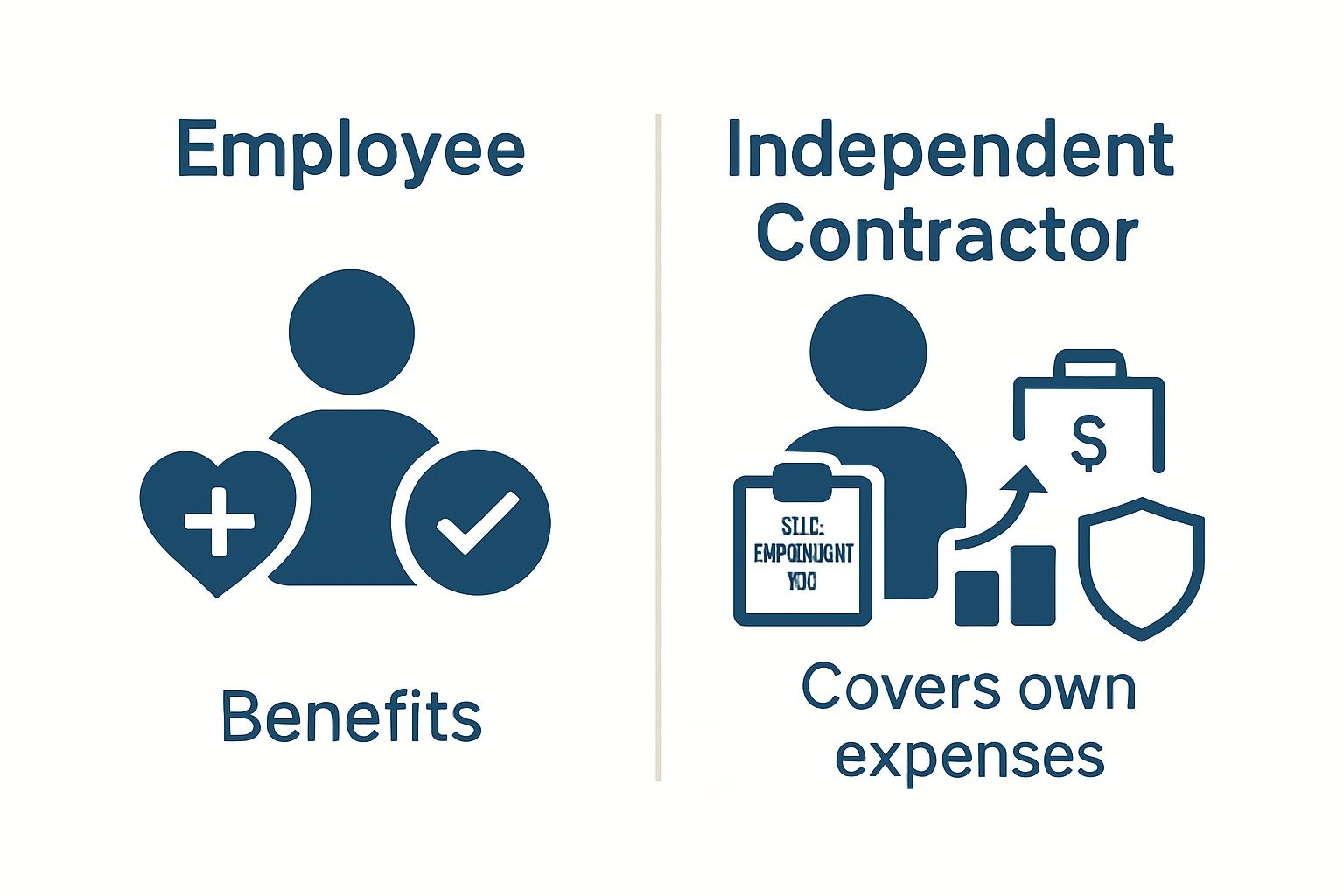
- Degree of control exercised by the employer
- Worker’s opportunity for profit or loss
- Permanence of the working relationship
- Required skill and initiative
- Level of independent business operation
Legal Standards and Precedents
Research from the Department of Labor highlights that worker misclassification is not determined by a single factor but through a comprehensive examination of the entire working relationship. The landmark California Supreme Court decision in Dynamex Operations West, Inc. v. Superior Court established the “ABC Test” as a critical standard for determining worker classification.
Key legal principles in misclassification claims include:
- Burden of proof typically falls on the employer
- Workers must demonstrate they were functionally employees
- Evidence of control and economic dependence is crucial
- Contractual language alone does not determine status
Misclassification claims represent more than legal technicalities. They are fundamental challenges to corporate practices that seek to minimize labor costs by shifting economic risks onto workers, ultimately questioning the fairness of modern employment models in the gig economy.
Real-World Examples of Misclassification Cases
Misclassification lawsuits provide powerful insights into how companies manipulate worker classification to reduce labor expenses and shift economic risks. These real-world cases demonstrate the complex legal battles workers face when challenging their employment status.
Landmark Delivery Worker Misclassification Cases
Learn more about California employment law nuances that impact worker rights. Several high-profile cases have significantly shaped understanding of worker misclassification in the delivery and gig economy sectors.
Notable misclassification cases include:
- Uber Technologies Inc. settlement for $8.4 million in California
- FedEx Ground package drivers lawsuit resulting in $240 million settlement
- Amazon Flex drivers class action lawsuit challenging contractor status
- DoorDash settlement addressing worker classification issues
Economic and Legal Implications
Research from the Economic Policy Institute reveals that these legal challenges extend beyond individual compensation. The implications of these cases fundamentally challenge business models that rely on misclassifying workers.
Key outcomes of these misclassification cases demonstrate:
- Significant financial penalties for companies
- Potential reclassification of workers as employees
- Requirement to provide backdated benefits
- Increased scrutiny of gig economy employment practices
These real-world examples illustrate that misclassification is not a minor administrative issue but a systemic problem affecting thousands of workers’ economic security and workplace rights.

The Legal Framework Surrounding Misclassification
The legal framework governing worker classification is a complex landscape of federal and state regulations designed to protect workers and ensure fair employment practices. These frameworks establish critical guidelines for determining appropriate worker status and potential legal recourse.
Federal and State Regulatory Standards
Explore our comprehensive guide on misclassification legal archives to understand the intricate legal mechanisms at play. The primary federal laws addressing worker classification include the Fair Labor Standards Act (FLSA) and Internal Revenue Service guidelines, which provide foundational criteria for distinguishing between employees and independent contractors.
Key federal regulatory standards encompass:
- Examining economic dependence of the worker
- Evaluating degree of employer control
- Analyzing financial investment by the worker
- Assessing permanence of the working relationship
- Determining skill requirements for the job
Enforcement Mechanisms and Worker Protections
Research from the U.S. Department of Labor demonstrates that multiple enforcement mechanisms exist to address worker misclassification. These include administrative investigations, legal actions, financial penalties, and potential mandatory reclassification of workers.
Significant legal protections for workers include:
- Right to challenge misclassification status
- Potential recovery of back wages
- Access to employment benefits
- Protection against retaliatory actions
- Ability to file complaints with regulatory agencies
The legal framework surrounding misclassification represents a critical safeguard for workers, ensuring that companies cannot arbitrarily circumvent established employment protections and workers receive appropriate compensation and benefits consistent with their actual working relationship.
Stand Up for Your Rights in Misclassification Lawsuits
If you are a delivery worker facing uncertainty about your employment status with companies like Amazon Flex, you already know the risks and costs of misclassification. Lost wages, unpaid overtime, lack of health insurance, and the burden of covering your own job expenses can quickly add up. The fear of being denied basic protections is real, and it can leave you questioning where to turn next. Understanding the difference between employee and contractor status is the first step, but acting on your rights takes professional guidance.
You do not have to navigate this fight alone. Our team at Serendib Law Firm has deep experience representing workers in complex misclassification claims. Explore our Misclassification Archives for insights on similar cases, or learn more about your protections under California Employment Law. If you believe you have been misclassified, contact us today for a free consultation and get a dedicated advocate on your side. Your financial security and workplace dignity deserve immediate action—make the call now.
Frequently Asked Questions
What is a misclassification lawsuit against delivery companies like Amazon Flex?
A misclassification lawsuit arises when a delivery company wrongly categorizes its workers as independent contractors instead of employees, denying them important workplace protections. To understand your situation, review your employment classification and its implications on benefits.
How do I determine if I’m misclassified as an independent contractor?
To assess whether you’re misclassified, evaluate factors such as the level of control the delivery company has over your work, your investment in equipment, and the permanence of your working relationship. Examine these characteristics closely and consider consulting an employment attorney for a detailed evaluation.
What are the potential financial consequences of a misclassification lawsuit for delivery workers?
Misclassified delivery workers can lose access to health insurance, overtime pay, unemployment benefits, and more. Calculate the potential back wages you may be owed by identifying the hours you worked and the benefits you did not receive over the last year.
What steps should I take if I believe I have been misclassified?
If you suspect misclassification, first document your working conditions and any communications with the company regarding your classification. Then, consider contacting an attorney who specializes in employment law to discuss your rights and potential legal actions.
What are the outcomes of successful misclassification lawsuits?
Successful misclassification lawsuits can lead to financial compensation for back wages and potential reclassification as employees, which would instate various employment benefits. If you initiate a claim, be prepared to provide evidence showing the nature of your work relationship and how it aligns with employee criteria.
How can misclassification impact the gig economy as a whole?
Misclassification can create significant economic and legal challenges within the gig economy, including financial penalties for companies and better protection for workers. Stay informed on industry trends and legal changes to understand how these issues could affect your employment status in the future.
Recommended
- Understanding Misclassification of Gig Workers
- Gig Workers Misclassification under California Law Updates
- Misclassification Archives | Serendib Law Firm
- Misclassification Archives | Serendib Law Firm
https://www.serendiblaw.com/misclassification-lawsuits-amazon-flex/?fsp_sid=78


Comments
Post a Comment