Complete Guide to Manager Misclassification in Tech

More than 60 percent of tech managers report confusion over their job classification and wage eligibility. This confusion matters because a single misstep can cost both workers and companies thousands in lost wages and penalties. With job titles changing fast and companies seeking flexibility, it is easier than ever to cross legal lines without realizing it. Understanding how misclassification really works in the tech world puts you on solid ground for fair treatment and smart business practices.
Table of Contents
- Defining Manager Misclassification In Tech Companies
- California Overtime Laws For Tech Managers
- Legal Criteria: Exempt Vs. Non-Exempt Status
- Common Schemes And Employer Tactics Explained
- Rights, Protections, And Employee Legal Remedies
- Risks And Consequences For Tech Employers
Key Takeaways
| Point | Details |
|---|---|
| Manager Misclassification | Tech companies may improperly classify non-managerial roles as exempt, risking legal violations and financial penalties. |
| California Overtime Laws | Compliance with California’s unique overtime regulations is essential; tech employers must assess job functions and compensation structures accurately. |
| Legal Protections for Employees | Employees have the right to challenge misclassification, seek unpaid wages, and obtain legal remedies without fear of retaliation. |
| Risks for Employers | Misclassification can lead to significant financial liabilities, reputational harm, and operational challenges for tech companies. |
Defining Manager Misclassification in Tech Companies
Manager misclassification represents a complex legal challenge where technology companies improperly categorize employees, potentially violating critical wage and employment regulations. In the tech industry, this occurs when organizations incorrectly label managers as exempt employees to avoid paying overtime compensation or providing certain workplace protections.
Misclassification happens when tech companies strategically designate roles that should technically qualify for hourly wages and overtime as salaried positions instead. This practice often involves creating job titles that sound managerial but do not actually meet the legal definition of management under employment law. Employees might have “manager” in their title but spend most of their time performing non-supervisory tasks like individual contributor work, customer service, or routine operational duties.
The consequences of misclassification can be significant for both employees and employers. Workers may lose out on critical wage protections, overtime pay, and benefits they legally deserve. Tech companies risk substantial financial penalties, including back wage payments, potential class action lawsuits, and regulatory sanctions. Misclassification of Managers: Complete Legal Guide provides detailed insights into these complex legal nuances.
Key indicators of potential manager misclassification in tech include:
- Limited genuine supervisory responsibilities
- Minimal authority to make meaningful employment decisions
- Spending less than 50% of work time on management tasks
- Compensation structures that do not reflect true management roles
- Job duties substantially similar to non-exempt employees
Tech companies must carefully evaluate job classifications, ensuring they align with legal standards that define genuine management positions.
 Understanding these distinctions is crucial for maintaining fair workplace practices and avoiding potentially expensive legal complications.
California Overtime Laws for Tech Managers
California has established sophisticated overtime regulations specifically tailored to the technology sector, creating unique legal standards for tech managers and software professionals. California Department of Industrial Relations provides detailed guidelines that distinguish between exempt and non-exempt technology employees, with critical implications for compensation and workplace rights.
Overtime exemptions in California’s tech industry depend on multiple sophisticated criteria. According to state regulations, computer software professionals must meet specific hourly compensation thresholds to qualify for exempt status. These thresholds are not static but are dynamically adjusted annually based on the California Consumer Price Index, ensuring that wage standards evolve with economic conditions.
Overtime Pay FAQ highlights that tech managers must satisfy stringent requirements to be classified as exempt. Key criteria include:
- Earning a minimum monthly salary well above standard wage rates
- Performing primarily intellectual or creative work
- Exercising independent discretion and judgment
- Spending more than 50% of work time on management or specialized technology tasks
The legal landscape for tech managers is complex. Companies must carefully analyze job responsibilities, compensation structures, and actual work performed to ensure compliance. Misclassification can result in significant financial penalties, including back wage payments, potential legal settlements, and regulatory sanctions. Tech professionals should understand their rights and carefully review their job classifications to protect their legal interests.
Legal Criteria: Exempt vs. Non-Exempt Status
Navigating the complex landscape of exempt and non-exempt status requires a nuanced understanding of California’s labor regulations. California Department of Industrial Relations provides comprehensive wage orders that establish critical distinctions between employees who are entitled to overtime pay and those who are exempt from such requirements.
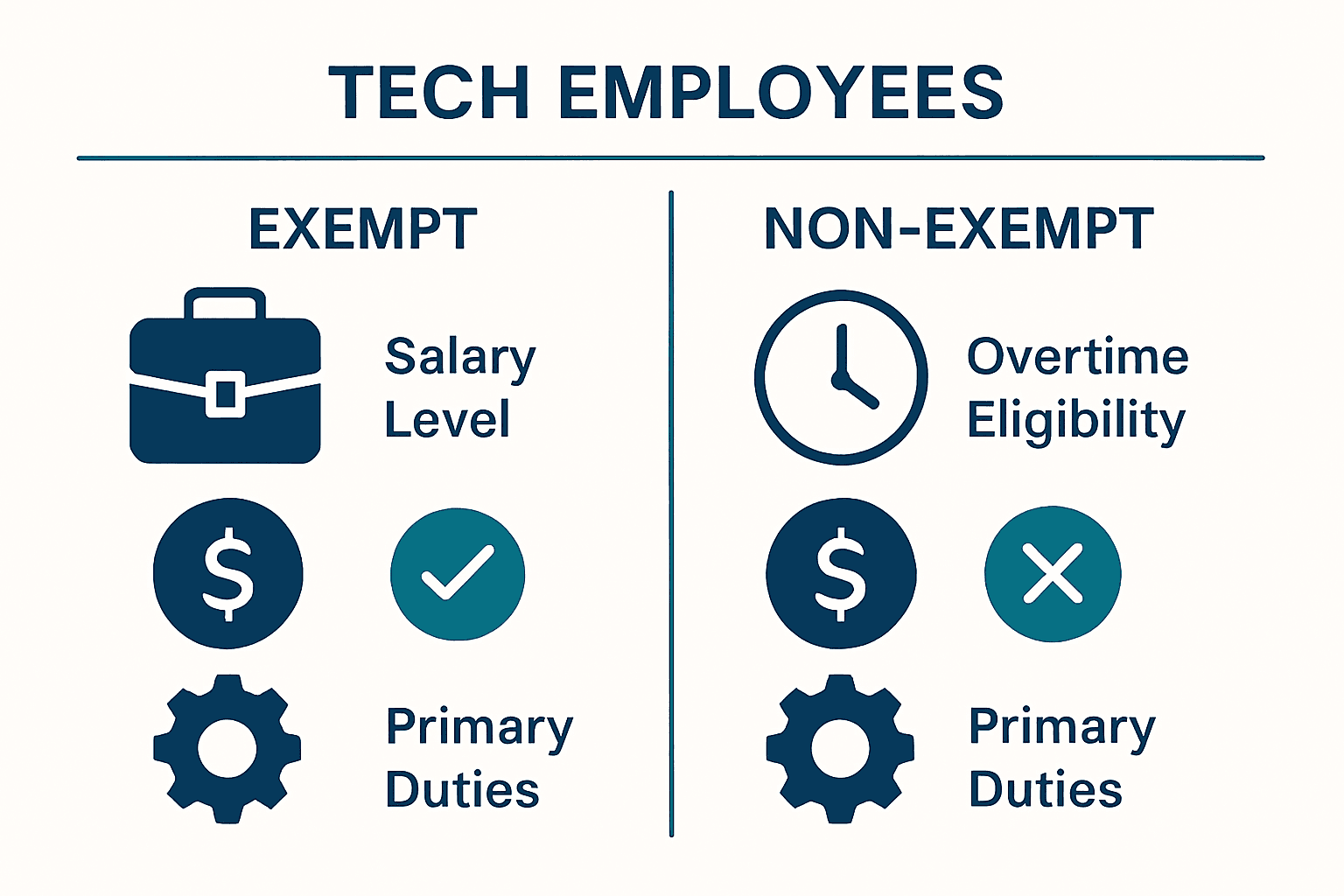
Exempt status in tech companies hinges on multiple sophisticated legal criteria. Employees must typically satisfy three primary conditions: salary level, salary basis, and job duties test. This means workers must earn above a specific monthly threshold, receive a predetermined salary regardless of hours worked, and perform primarily executive, administrative, or professional duties that require independent judgment and specialized knowledge.
Key differences between exempt and non-exempt tech employees include:
Here’s a comparison of exempt and non-exempt status requirements for tech employees:
| Criteria | Exempt Tech Employee | Non-Exempt Tech Employee |
|---|---|---|
| Salary Level | Above legal threshold | At or below threshold |
| Compensation Structure | Fixed salary | Hourly wages |
| Overtime Eligibility | Not eligible | Eligible |
| Primary Duties | Executive, admin, or professional | Routine or operational tasks |
| Independent Judgment | High discretion | Limited discretion |
| Management Time (>50%) | Required | Not required |
| Specialized Knowledge | Yes | Not required |
- Compensation structure (salary vs. hourly)
- Overtime eligibility
- Professional discretion and decision-making authority
- Complexity of job responsibilities
- Level of specialized expertise required
Experienced Orange Employment Law Attorneys emphasize that misclassification can result in significant legal and financial consequences. Tech companies must meticulously evaluate each role, considering not just job titles but actual day-to-day responsibilities. The burden of proof lies with employers to demonstrate that an employee genuinely meets the stringent exempt classification criteria, making careful documentation and ongoing assessment crucial for legal compliance.
Common Schemes and Employer Tactics Explained
Manager misclassification often emerges through sophisticated manipulation of job descriptions and compensation structures designed to exploit legal gray areas. Tech companies frequently deploy strategic tactics that deliberately blur the lines between exempt and non-exempt employee classifications to minimize labor costs and avoid overtime payments.
Misclassification schemes typically involve several calculated approaches. Employers might create elaborate job titles that sound managerial while purposefully structuring roles to include minimal supervisory responsibilities. This allows companies to classify employees as exempt without genuinely providing management-level authority or decision-making power. Misclassification of Managers: Complete Legal Guide highlights how these tactics can constitute legal violations.
Common employer misclassification tactics include:
- Creating inflated job titles without corresponding responsibilities
- Requiring extensive overtime without additional compensation
- Presenting salaried positions that functionally operate like hourly roles
- Deliberately minimizing documentation of actual job duties
- Implementing complex compensation structures that obscure true employment status
Tech professionals must remain vigilant and understand that job titles alone do not determine legal classification. Employers bear the legal burden of proving an employee’s exempt status, which requires demonstrating genuine management responsibilities, independent decision-making authority, and compensation that reflects true professional-level work. Recognizing these tactics is the first step in protecting workplace rights and challenging potentially illegal employment practices.
Rights, Protections, and Employee Legal Remedies
Tech employees facing misclassification have robust legal protections designed to safeguard their workplace rights and ensure fair compensation. Understanding these rights is crucial for challenging potentially illegal employment practices and securing appropriate remedies for wage theft and workplace violations.
Legal remedies for misclassified tech workers can take multiple strategic forms. Employees may pursue claims for unpaid overtime, recover back wages, and seek compensation for denied benefits. Employee Rights List For Everyone: 8 Key Elements outlines the fundamental protections workers can leverage when confronting systemic misclassification in technology companies.
Key legal protections and potential remedies include:
- Filing wage claims with state labor departments
- Pursuing individual or class action lawsuits
- Recovering unpaid overtime compensation
- Challenging misclassification through administrative complaints
- Seeking penalties and damages for systemic employment violations
- Requesting reclassification of employment status
- Obtaining legal representation to investigate potential violations
Workplace Retaliation protections are critical for employees who report misclassification. Workers are legally shielded from retaliatory actions when they assert their rights, including termination, demotion, or harassment. This legal framework empowers tech professionals to challenge unfair employment practices without fear of workplace retaliation, ensuring they can defend their rights and seek appropriate legal remedies.
Risks and Consequences for Tech Employers
Manager misclassification exposes technology companies to substantial legal, financial, and reputational risks that can dramatically undermine organizational stability and financial health. The consequences extend far beyond simple monetary penalties, potentially threatening a company’s entire operational framework and market credibility.
Financial consequences represent the most immediate and tangible risk for tech employers. Companies found guilty of misclassification can face significant financial liabilities, including back wage payments, overtime compensation, potential class action lawsuit settlements, and substantial government-imposed penalties. Whistleblower Retaliation in Tech Startups: Employee Rights highlights the additional legal complexities that emerge when employees challenge these practices.
Key risks and potential consequences for tech employers include:
- Mandatory payment of back wages and overtime compensation
- Substantial financial penalties from state and federal labor departments
- Potential class action lawsuit expenses
- Significant legal defense costs
- Mandatory reclassification of employee positions
- Potential suspension of business licenses
- Severe reputational damage in the technology industry
- Increased scrutiny from regulatory agencies
Beyond immediate financial implications, misclassification can trigger long-term strategic challenges. Companies may face diminished employee trust, increased workforce turnover, and potential difficulties in recruiting top talent. The reputational damage from legal violations can persist far longer than the initial financial penalties, potentially impacting investor confidence, customer perceptions, and the organization’s overall market positioning.
Protect Your Rights Against Manager Misclassification in Tech
Manager misclassification is a serious issue that can cost tech employees thousands in unpaid overtime and lost benefits. If your job title says “manager” but your duties do not match legal standards, you might be facing wage violations and unfair treatment. Understanding your classification status is the first step toward reclaiming what you deserve.
Don’t let complex misclassification schemes leave you vulnerable. Our experienced team is ready to help you navigate these challenges with personalized support. Explore how we combat misclassification and wage violations through our Misclassification Archives | Serendib Law Firm and Wage Violations Archives | Serendib Law Firm to learn more.
Take control of your employment rights today. Visit Serendib Law Firm for a free consultation and let us fight for the fair compensation and protections you legally deserve.
Frequently Asked Questions
What is manager misclassification in tech companies?
Manager misclassification occurs when tech companies incorrectly classify employees with managerial titles as exempt from overtime pay, often to avoid legal obligations related to wage and employment protections.
What are some key indicators of potential manager misclassification?
Key indicators include limited genuine supervisory responsibilities, spending less than 50% of work time on management tasks, and job duties that resemble non-exempt roles.
What are the legal criteria for determining exempt versus non-exempt status for tech employees?
Exempt status requires meeting specific criteria, including a minimum salary threshold, a fixed salary basis, and performing primarily executive, administrative, or professional duties with a high level of independent judgment.
What rights do tech employees have if they suspect misclassification?
Tech employees have the right to file wage claims, seek unpaid overtime compensation, pursue class action lawsuits, and obtain legal representation to challenge misclassification and protect their workplace rights.
Recommended
- Misclassification of Managers: Complete Legal Guide
- Understanding Misclassification of Gig Workers
- Complete Guide to Misclassification in Logistics Law | Serendib Law Firm
- Gig Workers Misclassification under California Law Updates
https://www.serendiblaw.com/manager-misclassification-tech-villa-park/?fsp_sid=146


Comments
Post a Comment