Religious Dress Code Discrimination: Complete Guide

Did you know that nearly one in five religious discrimination complaints filed with the EEOC involve workplace dress or grooming issues? These cases highlight real struggles faced by employees who express their faith through what they wear. Employers and workers alike need to understand the laws that protect individual religious expression, which go well beyond common policies. Clarity on these protections can help build workplaces that honor both diversity and legal rights.
Key Takeaways
| Point | Details |
|---|---|
| Religious Dress Code Discrimination | Employers must accommodate religious attire and grooming practices as per Title VII, ensuring no undue hardship is imposed on operations. |
| Nuanced Protections | Both federal law and California’s FEHA prohibit discrimination based on sincerely held religious beliefs, demanding proactive accommodations from employers. |
| Employer Responsibilities | Employers should evaluate accommodation requests sincerely and engage in cooperative dialogue, documenting all attempts to accommodate religious practices. |
| Employee Rights | Employees are legally protected against discrimination, harassment, and retaliation regarding their religious dress and grooming choices in the workplace. |
Table of Contents
- Defining Religious Dress Code Discrimination
- Religious Dress Practices And Variations
- Federal And California Laws On Religious Apparel
- Employer Responsibilities And Accommodation Duties
- Employee Rights And Legal Protections
- Reporting, Remedies, And Litigation Risks
Defining Religious Dress Code Discrimination
Religious dress code discrimination occurs when employers unfairly treat employees based on their religious attire, grooming practices, or appearance related to sincerely held religious beliefs. Title VII provides comprehensive protections that extend far beyond mainstream religious practices, ensuring workers can express their faith without workplace penalties.
According to the Equal Employment Opportunity Commission, religious discrimination encompasses much more than most people realize. The law requires employers to reasonably accommodate religious dress and grooming practices, including:
- Hijabs and headscarves
- Yarmulkes and kippahs
- Turbans
- Religious facial hair
- Traditional cultural garments
The critical legal standard centers on whether an accommodation would impose more than a minimal burden on the employer. As outlined by EEOC guidance, employers must make sincere efforts to adjust workplace policies unless doing so creates substantive operational challenges. This means if an employee’s religious dress doesn’t significantly disrupt work processes, the employer must find a way to accommodate their practice.
Workplace religious dress protections are nuanced and complex. They apply equally to mainstream and minority religious practices, protecting an individual’s right to express their faith through appearance while maintaining professional standards. The key is demonstrating that the religious practice is sincerely held and does not create unreasonable workplace difficulties.

Religious Dress Practices and Variations
Religious dress practices encompass a diverse range of clothing, grooming, and accessory choices that reflect deeply held spiritual beliefs across various faith traditions. According to the Equal Employment Opportunity Commission, these practices extend far beyond simple wardrobe choices and represent fundamental expressions of religious identity.
Some common religious dress and grooming practices include:
- Head Coverings: Hijabs, turbans, yarmulkes, and other traditional head coverings
- Jewelry and Articles of Faith: Crosses, stars of David, religious medallions, kirpans
- Modest Clothing: Long dresses, specific color requirements, covered shoulders or legs
- Grooming Practices: Uncut hair, specific beard styles, avoiding certain haircuts
Crucially, EEOC publications emphasize that Title VII protections apply even when religious practices might appear similar to secular choices. The key distinction is the religious motivation behind the dress or grooming practice. This means an employee’s religious expression is protected regardless of whether others might perceive it as a personal style choice.
Navigating religious dress variations requires employers to approach each situation with cultural sensitivity and legal awareness. Understanding that religious dress is not just about clothing, but a profound personal and spiritual expression, is fundamental to creating an inclusive workplace environment that respects individual beliefs and legal rights.
Federal and California Laws on Religious Apparel
Religious apparel protections span both federal and state legal frameworks, with Title VII establishing baseline national standards and California’s Fair Employment and Housing Act (FEHA) providing even more robust workplace safeguards. According to the Equal Employment Opportunity Commission, federal law requires employers to make exceptions to standard dress codes for religious practices unless such accommodations create undue hardship.
Key differences between federal and California laws include:
- Federal Standard: Allows accommodation exceptions with “minimal” business disruption
- California Standard: Requires more extensive accommodation exploration
- Customer Preference: Explicitly NOT a valid reason to deny religious dress accommodations
- Burden of Proof: California places higher requirements on employers to demonstrate true hardship
A research highlights that California’s legal approach is significantly more employee-friendly. The state explicitly prohibits workplace segregation based on religious dress and mandates that employers thoroughly document and explore all possible reasonable accommodations before claiming an undue hardship.
Employees in California enjoy particularly strong protections, with state laws going beyond federal requirements to ensure comprehensive religious expression rights in the workplace. This means employers must take proactive steps to understand, respect, and accommodate diverse religious dress practices, making genuine efforts to create inclusive work environments that honor individual spiritual beliefs.
Here’s a comparison of religious dress protection standards under federal and California law:
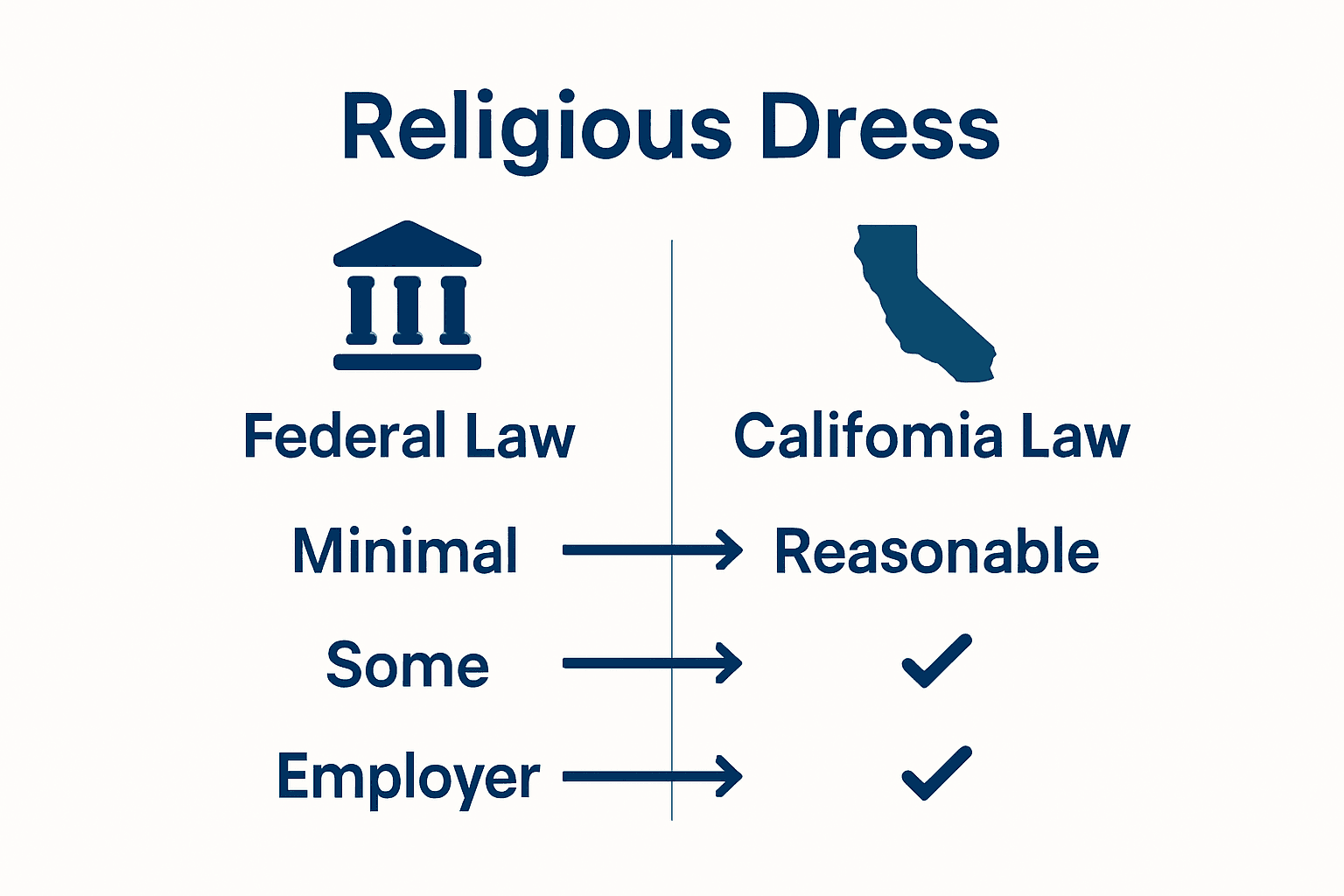
| Protection Aspect | Federal Law (Title VII) | California Law (FEHA) |
|---|---|---|
| Accommodation Standard | Minimal burden on employer | Higher employer obligations |
| Required Effort | Reasonable accommodation | Explore all alternatives |
| Customer Preferences | Not a valid reason | Not a valid reason |
| Segregation Allowed | Explicitly prohibited | Explicitly prohibited |
| Burden of Proof | On employer, less strict | On employer, more strict |
Employer Responsibilities and Accommodation Duties
Employer accommodation duties represent a critical legal obligation when addressing religious dress and grooming practices in the workplace. According to the Equal Employment Opportunity Commission, employers must engage cooperatively and proactively when an employee requests a religious accommodation, evaluating each situation with careful consideration and genuine intent.
Key employer responsibilities include:
- Sincere Evaluation: Assess the authenticity of religious practice claims
- Cooperative Dialogue: Engage in meaningful discussions about potential accommodations
- Flexible Solutions: Consider multiple options like:
- Job task adjustments
- Lateral transfers
- Dress code exceptions
- Document Everything: Maintain clear records of accommodation attempts
California law, as highlighted by Seyfarth Shaw, imposes even stricter standards. Employers cannot simply reject accommodations based on minimal inconvenience. They must thoroughly explore alternatives and cannot segregate employees based on religious dress, which means finding inclusive solutions that respect both workplace needs and individual beliefs.
Navigating these responsibilities requires employers to move beyond compliance and embrace a culture of genuine respect. This means understanding that religious accommodations are not optional extras, but fundamental rights. For comprehensive guidance on employment law protections, employers should consult legal professionals who can help them create inclusive, legally compliant workplace environments that honor diverse religious expressions.
Employee Rights and Legal Protections
Religious expression rights in the workplace are fundamental protections guaranteed by federal and state laws. According to the Equal Employment Opportunity Commission, employees have comprehensive legal safeguards that protect their ability to practice and express their religious beliefs through dress and grooming without fear of workplace discrimination.
Employees are specifically protected against:
- Discriminatory Refusal: Employers cannot deny reasonable religious accommodations
- Workplace Segregation: Preventing assignment to less visible or desirable positions
- Harassment: Preventing derogatory comments or hostile work environments
- Retaliation: Protecting employees who request religious accommodations
As outlined by Title VII guidance, these protections extend to all sincerely held religious beliefs, not just mainstream religious practices. This means employers must treat religious dress and grooming practices with respect, regardless of whether they understand or agree with the specific religious tradition.
Understanding these rights is crucial. Employees who experience discrimination can seek comprehensive legal support from experienced employment law attorneys who can help them navigate complex workplace religious discrimination issues. The law is clear: your right to express your religious identity is protected, and no employer can systematically undermine or marginalize that fundamental freedom.
Reporting, Remedies, and Litigation Risks
Religious discrimination claims represent significant legal vulnerabilities for employers who fail to appropriately accommodate religious dress and grooming practices. According to the Equal Employment Opportunity Commission, employees have clear pathways to challenge discriminatory workplace practices through formal reporting mechanisms.
Employees facing religious dress discrimination can pursue multiple avenues:
- EEOC Complaint: File an official charge of discrimination
- Internal Grievance: Use workplace complaint procedures
- Legal Action: Pursue litigation for damages and remedies
- Potential Remedies:
- Monetary compensation
- Reinstatement
- Policy changes
- Mandatory workplace training
A compelling recent example emerges from Associated Press reporting, where the U.S. Justice Department challenged California’s facial-hair ban for prison guards, demonstrating how institutional policies can face substantial legal scrutiny when they conflict with religious practices. This case underscores the significant litigation risks organizations face when implementing inflexible dress and grooming standards.
For those navigating potential whistleblower retaliation concerns, understanding your rights is crucial. Employers who retaliate against employees reporting religious discrimination can face severe financial and legal consequences, making proactive accommodation and respectful workplace practices not just ethical, but economically prudent.
Protect Your Right to Religious Expression at Work
Are you worried about unfair treatment at work because of your religious dress or grooming practices? This guide explains how discrimination can undermine your sense of safety and belonging on the job. If you are facing challenges like denied accommodations, unwanted segregation, or retaliation for expressing your faith, you do not have to handle this alone. The pressure to choose between your beliefs and your job is not something you should ever accept.
Let the experienced team at Serendib Law Firm defend your freedom to express your religion at work. Our attorneys understand the nuances of religious dress protections under both federal and California law. Visit our Religious Discrimination Archives for practical legal insights on these issues or explore how we can take action on your behalf. Your right to reasonable accommodation is protected and time matters if you want to secure evidence or file a claim. Take the first step and reach out for a free consultation today. It is your faith and your future. We are ready to help you protect both.
Frequently Asked Questions
What is religious dress code discrimination?
Religious dress code discrimination occurs when employers unfairly treat employees based on their religious attire, grooming practices, or appearance related to sincerely held religious beliefs. It includes a lack of reasonable accommodation for an employee’s religious practices unless it imposes more than a minimal burden on the employer.
What are employers obligated to do regarding religious dress and grooming practices?
Employers must reasonably accommodate employees’ religious dress and grooming practices unless doing so creates undue hardship. They are required to engage in cooperative dialogue, consider flexible solutions, and maintain clear records of accommodation attempts.
What protections do employees have against religious dress discrimination?
Employees are protected from discriminatory refusal of reasonable accommodations, workplace segregation, harassment, and retaliation for requesting religious accommodations. These protections apply to all sincerely held religious beliefs, ensuring the right to express one’s faith through dress and grooming.
What steps can employees take if they face religious discrimination?
Employees facing religious dress discrimination can file a complaint with the EEOC, utilize internal grievance procedures, pursue legal action for damages, and seek potential remedies such as monetary compensation, reinstatement, and policy changes.
Recommended
https://www.serendiblaw.com/religious-dress-code-discrimination/?fsp_sid=205


Comments
Post a Comment