Complete Guide to Commission Pay Disputes in California

Nearly 60 percent of sales professionals say they have experienced a commission pay dispute at some point in their career. These conflicts can mean thousands of dollars lost and often leave employees feeling frustrated and powerless. Understanding how commissions should be paid and what to do when things go wrong helps you protect your income, avoid costly mistakes, and ensure both workers and employers are held to fair standards.
Key Takeaways
| Point | Details |
|---|---|
| Commission Pay Disputes | Conflicts often arise when employers fail to comply with written commission agreements, including unauthorized deductions and withholding payments. |
| Legal Obligations | California mandates written commission agreements for all commissioned employees, ensuring clarity on how commissions are earned and paid. |
| Employee Rights | Employees have the right to file wage violation claims and must receive payment for all earned commissions, especially upon termination. |
| Resolution Strategies | Dispute resolution should start with thorough documentation and can include administrative procedures like Berman hearings for efficient outcomes. |
Table of Contents
- Commission Pay Disputes Defined And Explained
- Types Of Commission Structures In Sales Roles
- Legal Framework Governing Commission Pay In California
- Common Causes Of Commission Pay Disputes
- Employee Rights And Employer Obligations In Disputes
- Steps To Resolve And Prevent Commission Pay Issues
Commission Pay Disputes Defined and Explained
A commission pay dispute occurs when conflicts emerge between employees and employers regarding earned compensation based on sales performance or contractual agreements. According to research from Ruggles Law Firm, these disputes frequently arise when employers fail to honor the explicit terms of a written commission agreement.
Typical commission pay disputes can involve several complex scenarios:
- Failure to pay fully earned commissions
- Applying unauthorized deductions or chargebacks
- Withholding payment based on unstated conditions
- Retroactively changing compensation terms
- Refusing to provide a transparent accounting of commission payments
In California, the law mandates that commission agreements must be clear, express, complete, and documented in writing. Research indicates that disputes often emerge when employees leave before commissions are paid or when employers attempt to improperly shift business costs onto employees. This can constitute a breach of contract or mischaracterization of compensation entitlements.
Understanding your rights and the specific terms of your commission agreement is crucial. Employees should carefully review their contracts, maintain detailed records of sales and performance, and seek legal guidance if they believe their earned commissions are being unfairly withheld.
Types of Commission Structures in Sales Roles
Sales compensation models are complex, dynamic frameworks designed to motivate and reward performance while balancing employer and employee interests. According to research from expert sources, B2B commission structures can take several strategic forms, each with unique advantages and challenges.
Base Salary Plus Commission
In this traditional compensation model, sales professionals receive a guaranteed base salary supplemented by performance-based commissions. The salary-to-commission ratio typically varies based on:
- Sales representative’s experience level
- Industry complexity
- Role-specific expectations
- Company revenue goals
Tiered Commission Structures
A tiered commission approach creates escalating compensation rates as sales representatives hit specific performance thresholds. This motivational structure encourages continuous improvement by offering progressively higher commission percentages when predetermined sales targets are achieved.
Performance-Driven Models
Here’s a comparison of common commission structures:
| Commission Structure | Base Salary | Incentive Motivation | Risk Level |
|---|---|---|---|
| Base Salary + Commission | Guaranteed pay | Moderate - sales bonus | Low |
| Tiered Commission | Yes/optional | High - targets increase rate | Moderate |
| Performance-Driven Models | Optional/none | Very High - profit focus | High |
| Commission-Only | None or draw | Maximum - all sales-based | Very High |
| Some advanced compensation strategies focus on profitability alignment, such as gross margin commissions. These structures incentivize sales representatives not just to close deals, but to prioritize high-value, profitable transactions that contribute meaningfully to the company’s bottom line. Commission-only models represent the most aggressive approach, offering high-risk, high-reward compensation entirely dependent on sales performance, sometimes incorporating draw-against-commission mechanisms to provide baseline financial stability. |

Legal Framework Governing Commission Pay in California
California’s legal landscape for commission pay is complex and employee-protective. Our detailed commission pay guide outlines critical protections that ensure fair compensation for sales professionals. The state has established robust regulations to prevent employer wage manipulation and guarantee transparent payment structures.
Minimum Wage and Compensation Requirements
According to research from Littler Legal Insights, the California Supreme Court’s landmark Peabody v. Time Warner Cable decision established crucial guidelines for commissioned employees:
- Employers cannot use future commissions to satisfy minimum wage requirements for prior pay periods
- Exempt commissioned employees must be paid at least 1.5 times minimum wage
- Minimum wage must be paid for all hours worked in each pay period
Written Agreement Mandates
Written commission agreements are legally mandatory in California. Workplace Rights Law research highlights key provisions:
- Every commission-earning employee must have a documented agreement
- Employers are required to pay final commissions upon employee termination
- Penalties apply for failure to pay reasonably calculable commissions
- Employees have three to four years to file commission payment claims
Understanding these legal frameworks helps protect your rights and ensures fair compensation in commission-based roles.
Common Causes of Commission Pay Disputes
Commission pay disputes emerge from complex interactions between employer compensation policies and employee performance expectations. According to research from legal experts, these conflicts typically stem from several predictable scenarios that challenge fair compensation practices.
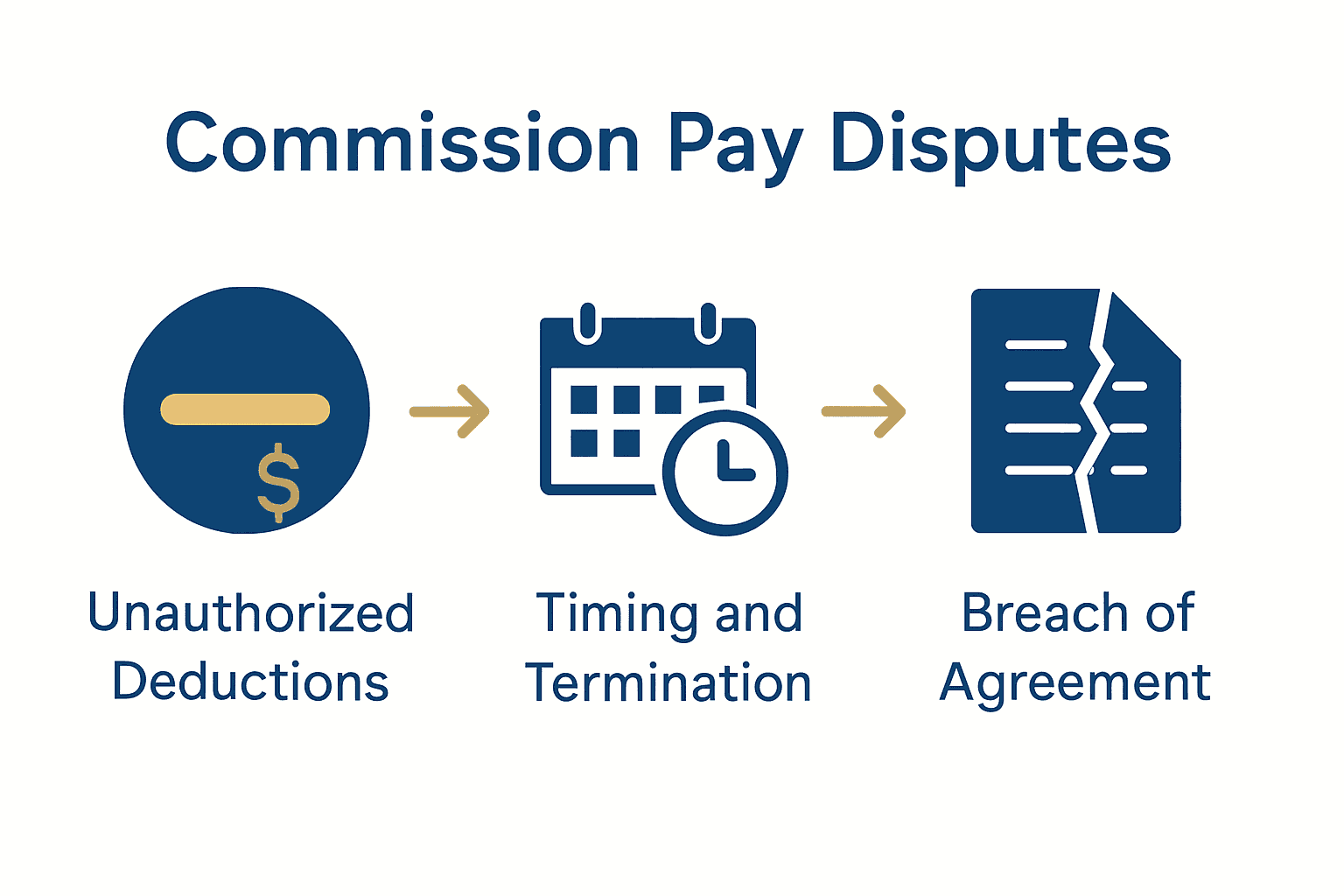
Unauthorized Withholding and Deductions
Payment manipulation represents a significant source of commission disputes. Research indicates that employers are generally prohibited from taking back earned commissions unless specific written agreement exceptions exist. Problematic deduction scenarios include:
- Attempting to recover general business losses
- Charging employees for operational expenses
- Penalizing workers for perceived negligence
- Implementing retroactive commission reductions
Timing and Termination Disputes
Commission disputes frequently arise during employment transitions, particularly around:
- Unpaid commissions after employee departure
- Delayed commission payments
- Breach of contractual bonus or commission terms
- Disagreements about earned but未払 commissions
Understandably, these conflicts can create significant financial strain and professional tension. Employees must carefully document their sales performance, understand their written agreements, and be prepared to assert their legal rights when commission payments are improperly withheld or manipulated.
Employee Rights and Employer Obligations in Disputes
Commission pay rights in California are comprehensive and designed to protect employees from unfair compensation practices. Our experienced Orange employment law attorneys understand the nuanced legal landscape that governs these critical workplace interactions.
Wage Classification and Payment Requirements
According to Los Angeles Employment Attorney research, commissions are legally classified as wages under California law. This classification provides significant protections for employees, including:
- Right to file wage violation claims for unpaid commissions
- Mandatory employer payment at least twice monthly
- Payment within the first pay period after commissions are earned
- Immediate payment upon termination for all earned commissions
Written Agreement Mandates
Contractual transparency is crucial in commission-based employment. Labor Code Section 2751 establishes strict requirements for commission agreements:
- All commission agreements must be in writing
- Agreements must detail how commissions are earned, calculated, and paid
- Employers must provide new signed agreements for any changes
- Commission-only employees may be overtime-exempt if:
- Over 50% of wages come from commissions
- Earnings are at least 1.5 times minimum wage
Understanding these rights empowers employees to protect their financial interests and hold employers accountable for fair compensation practices.
Steps to Resolve and Prevent Commission Pay Issues
Commission pay disputes require a strategic, methodical approach to resolution. Our employment law arbitration experts recommend a careful, documented process to protect both employee and employer interests.
Initial Documentation and Verification
According to Ruggles Law Firm research, the first critical step is thoroughly examining the written commission agreement. Key verification steps include:
- Confirm all disputed commissions match written agreement terms
- Identify specific deviations from documented compensation structures
- Gather comprehensive evidence of sales performance
- Document all communication regarding commission calculations
Administrative Resolution Strategies
Dispute resolution in California offers multiple pathways. Berman hearing procedures provide an efficient administrative alternative to traditional litigation:
- File a formal wage claim with the Labor Commissioner’s Office
- Attend a mandatory settlement conference
- Participate in an administrative hearing if settlement fails
- Receive a binding decision that can be converted to a court judgment
Preventing future disputes requires proactive communication, clear written agreements, and maintaining meticulous sales and payment documentation. When conflicts arise, a systematic approach focusing on factual evidence and legal compliance provides the most effective resolution strategy.
Take Control of Your Commission Dispute With Trusted Legal Guidance
If you are frustrated by withheld commissions, unclear compensation terms, or ongoing payroll conflicts, you are not alone. Many California sales professionals struggle to navigate missed payments, surprise deductions, or unfair changes in their commission structure. Our article explained how confusing legal rules and a lack of written agreement transparency can put your earnings at risk.
Get clarity and results with help from our award-winning team. Start by exploring our California Employment Law resources for in-depth legal insights tailored to California workers. Our attorneys have handled tough wage and commission cases like yours. Connect with us today through Serendib Law Firm and schedule a free, confidential consultation. Do not wait and risk losing the pay you have earned. Empower yourself and act now to secure your commission rights.
Frequently Asked Questions
What constitutes a commission pay dispute in California?
A commission pay dispute occurs when there are conflicts between employees and employers regarding earned compensation based on sales performance or agreed contractual terms.
What are common causes of commission pay disputes?
Common causes include unauthorized deductions, timing issues with commission payments, breach of contract, and failure to honor clear commission agreements.
What legal protections do employees have regarding commission pay in California?
California law mandates that all commission agreements must be in writing, requires employers to pay commissions promptly, and classifies commissions as wages, which gives employees the right to file claims for unpaid commissions.
What steps should I take if I believe my commission pay is being unfairly withheld?
You should carefully document your sales and commission agreements, gather evidence, and consider filing a formal wage claim with the Labor Commissioner’s Office if disputes cannot be resolved internally.
Recommended
- Commission Pay | Serendib Law Firm
- Wage and Hour Claims - General Rules and Violations | Serendib Law Firm
- Piece Rate Compensation | Serendib Law Firm
- California Overtime Disputes
- Facts on How to Claim Unpaid Wages You Need to Know
https://www.serendiblaw.com/commission-pay-disputes-california/?fsp_sid=317


Comments
Post a Comment