Misclassification of Contractors – Risks in Garden Grove

Most American construction workers in Garden Grove know someone who has been classified as an independent contractor when they deserved employee protections. This critical distinction shapes pay, benefits, and safety on the job. With California enacting strict rules and facing rising penalties, understanding your true employment status helps protect your wages and rights in a tough industry.
Table of Contents
- Defining Contractor Misclassification In Construction
- California’s ABC Test And Worker Status
- 2026 Legal Updates Impacting Construction Firms
- Employee Rights Versus Contractor Status
- Penalties, Liability, And The Amnesty Program
- Best Practices To Avoid Misclassification
Key Takeaways
| Point | Details |
|---|---|
| Worker Misclassification | Misclassifying workers as independent contractors can lead to loss of rights and benefits. Employers must adhere to the ABC Test in California to avoid this issue. |
| ABC Test Requirements | The ABC Test sets a high bar for classifying workers as independent contractors, focusing on autonomy and independence. Employers must meet all three criteria to prove non-employee status. |
| Updated Regulations in 2026 | New legislation in 2026 will impose stricter penalties and compliance requirements for construction firms. Companies must enhance internal systems to comply with upcoming regulatory changes. |
| Importance of Documentation | Both workers and employers should maintain thorough documentation of employment relationships to assess and uphold proper classifications and avoid legal challenges. |
Defining Contractor Misclassification in Construction
Contractor misclassification in construction represents a complex legal issue where workers are improperly categorized as independent contractors instead of employees. This systematic practice can significantly impact worker rights, compensation, and legal protections. Construction industry practices often blur the lines between traditional employment relationships and independent contracting arrangements.
Under federal and California state regulations, determining worker classification involves analyzing multiple factors beyond simple job titles. The economic realities test examines critical elements like degree of worker control, job integration, permanence of the working relationship, and financial investment in equipment or tools. Employers cannot arbitrarily decide worker status simply to reduce labor expenses or avoid providing benefits.
The construction sector historically demonstrates persistent misclassification challenges. California’s Assembly Bill 5 introduced stringent criteria specifically designed to protect workers by establishing clear guidelines for differentiating between genuine independent contractors and employees masquerading as contractors. These legal frameworks aim to prevent exploitation and ensure workers receive appropriate wage protections, overtime compensation, and workplace safety standards.
Pro Tip: Workers suspecting misclassification should document their work conditions, supervision level, and payment arrangements to support potential legal claims against improper employment categorization.
California’s ABC Test and Worker Status
The California ABC Test represents a groundbreaking legal standard for determining worker classification, establishing stringent criteria that protect workers from potential misclassification. California’s labor regulations create a presumption of employee status that requires employers to prove three specific conditions to classify a worker as an independent contractor.
Under the ABC Test, employers must demonstrate three critical elements simultaneously: First, the worker must be free from the company’s control and direction in performing work. Second, the worker must perform tasks outside the usual course of the company’s business operations. Third, the worker must be independently established in a trade or business similar to the work being performed. This multi-part test sets an intentionally high bar, making it challenging for businesses to classify workers as independent contractors.
Construction industry employers face particular scrutiny under these regulations. The test effectively limits misclassification by requiring comprehensive proof of true independent contractor status. Workers in Garden Grove and throughout California now have enhanced protections against potential exploitation, ensuring they receive appropriate wages, benefits, and workplace safeguards. Assembly Bill 5 codified these standards, transforming the landscape of employment classification and worker rights.
The table below highlights key differences between California’s traditional tests and the ABC Test for worker classification:
| Test Name | Key Criteria Evaluated | Application in Construction |
|---|---|---|
| Economic Realities Test | Worker control, job integration | Focused on nuanced, multi-factor review |
| ABC Test | Independence, business type, control | Presumes employment, strict 3-part test |
Pro Tip: Contractors should carefully document their business structure, independence, and professional autonomy to strengthen their case under the ABC Test criteria.
2026 Legal Updates Impacting Construction Firms
The construction industry in California is poised for significant regulatory changes in 2026, with new legislation targeting contractor accountability and compliance. These updates represent a comprehensive approach to strengthening worker protections, enhancing transparency, and imposing stricter penalties for regulatory violations.
Key legislative modifications will focus on several critical areas of construction firm operations. Contractors will face enhanced responsibilities regarding wage judgments, workers’ compensation insurance, and subcontractor disclosures. The California Contractors State License Board (CSLB) will implement more rigorous enforcement mechanisms, including increased civil penalties for non-compliance. Home improvement contracts will now require more detailed disclosures, creating additional transparency requirements for construction businesses operating in Garden Grove and throughout California.
The most significant changes target employer accountability, particularly concerning subcontractor practices. Construction firms will need to develop more robust internal compliance systems, conduct more thorough background checks, and maintain comprehensive documentation of worker classifications and compensation practices. These regulatory updates aim to minimize worker misclassification, prevent wage theft, and ensure more equitable working conditions across the construction industry.
Pro Tip: Construction firms should proactively review their current compliance protocols and consult with legal experts to ensure full alignment with the upcoming 2026 regulatory changes.
Employee Rights Versus Contractor Status
In the complex landscape of California labor law, the distinction between employee and independent contractor status carries profound legal and financial implications. California enforces robust protections that dramatically differentiate worker classifications, creating significant consequences for misclassified workers in industries like construction.
Employees in California are entitled to comprehensive rights and benefits that independent contractors are systematically denied. These protections include minimum wage guarantees, overtime compensation, paid sick leave, workers’ compensation insurance, unemployment benefits, and the critical right to collective bargaining. Independent contractors, by contrast, must negotiate their own compensation, purchase personal insurance, and shoulder substantially more financial risk in their professional arrangements.

Here’s a summary of how employee and independent contractor classifications impact rights and obligations:
| Category | Employee Benefits and Protections | Independent Contractor Responsibilities |
|---|---|---|
| Minimum Wage | Guaranteed by state law | Negotiates own pay rate |
| Overtime Pay | Eligible for overtime compensation | Not entitled to overtime |
| Workers’ Compensation | Employer-provided coverage | Must purchase own insurance |
| Unemployment Benefits | Employer pays into system | Not eligible |
| Job Security | Protected by labor regulations | Subject to contract terms |
| Tax Withholding | Employer handles taxes | Responsible for self-employment tax |
The legal landscape has evolved with Assembly Bill 5, which codified the stringent ABC test for worker classification. This legislation places the burden of proof on employers to demonstrate that a worker genuinely qualifies as an independent contractor. Construction firms in Garden Grove and across California must now navigate increasingly complex regulatory requirements, carefully examining factors like worker autonomy, business integration, and professional independence to ensure proper worker classification and avoid potential legal penalties.
Pro Tip: Workers uncertain about their classification should document their working conditions, level of supervision, and job responsibilities to accurately assess their true employment status.
Penalties, Liability, and the Amnesty Program
California’s legal framework for worker misclassification includes substantial financial and legal consequences designed to deter improper employment practices. Employers face significant penalties ranging from $5,000 to $25,000 for each violation, creating powerful incentives for accurate worker classification in industries like construction.
The financial liability extends far beyond immediate fines. Construction firms found guilty of misclassification can be held responsible for unpaid wages, back taxes, workers’ compensation insurance, unemployment insurance contributions, and potential civil litigation costs. These comprehensive penalties are strategically structured to make misclassification financially unsustainable and protect worker rights across Garden Grove and California.
To provide a pathway for correction, California has implemented strategic amnesty programs that allow employers to voluntarily rectify misclassification issues with reduced penalties. These programs recognize that some misclassifications occur through genuine misunderstanding rather than intentional exploitation. By offering a structured approach to reclassification, the state encourages proactive compliance and provides businesses an opportunity to align their practices with legal requirements without facing maximum punitive measures.
Pro Tip: Employers should conduct comprehensive internal audits of worker classifications and maintain detailed documentation to demonstrate good faith compliance efforts.
Best Practices to Avoid Misclassification
Construction firms in Garden Grove must proactively implement comprehensive strategies to mitigate worker misclassification risks. Conducting regular and thorough worker classification audits represents a critical first step in maintaining legal compliance and protecting both worker rights and business interests.
Effective misclassification prevention requires a multi-dimensional approach. Construction companies should develop robust internal protocols that meticulously examine the actual working relationships, not just contractual language. This involves carefully analyzing factors such as worker control, integration into business operations, financial investment, and the degree of independence. HR and management teams must receive comprehensive training on the nuanced ABC test criteria, ensuring they understand the complex legal distinctions between employees and independent contractors.
Documentation emerges as a crucial defense mechanism against potential misclassification claims. Employers should maintain detailed records that demonstrate the true nature of working relationships, including contracts, scope of work, payment structures, and evidence of worker autonomy. Implementing standardized review processes, seeking periodic legal consultations, and creating transparent communication channels with workers can significantly reduce the risk of unintentional misclassification.
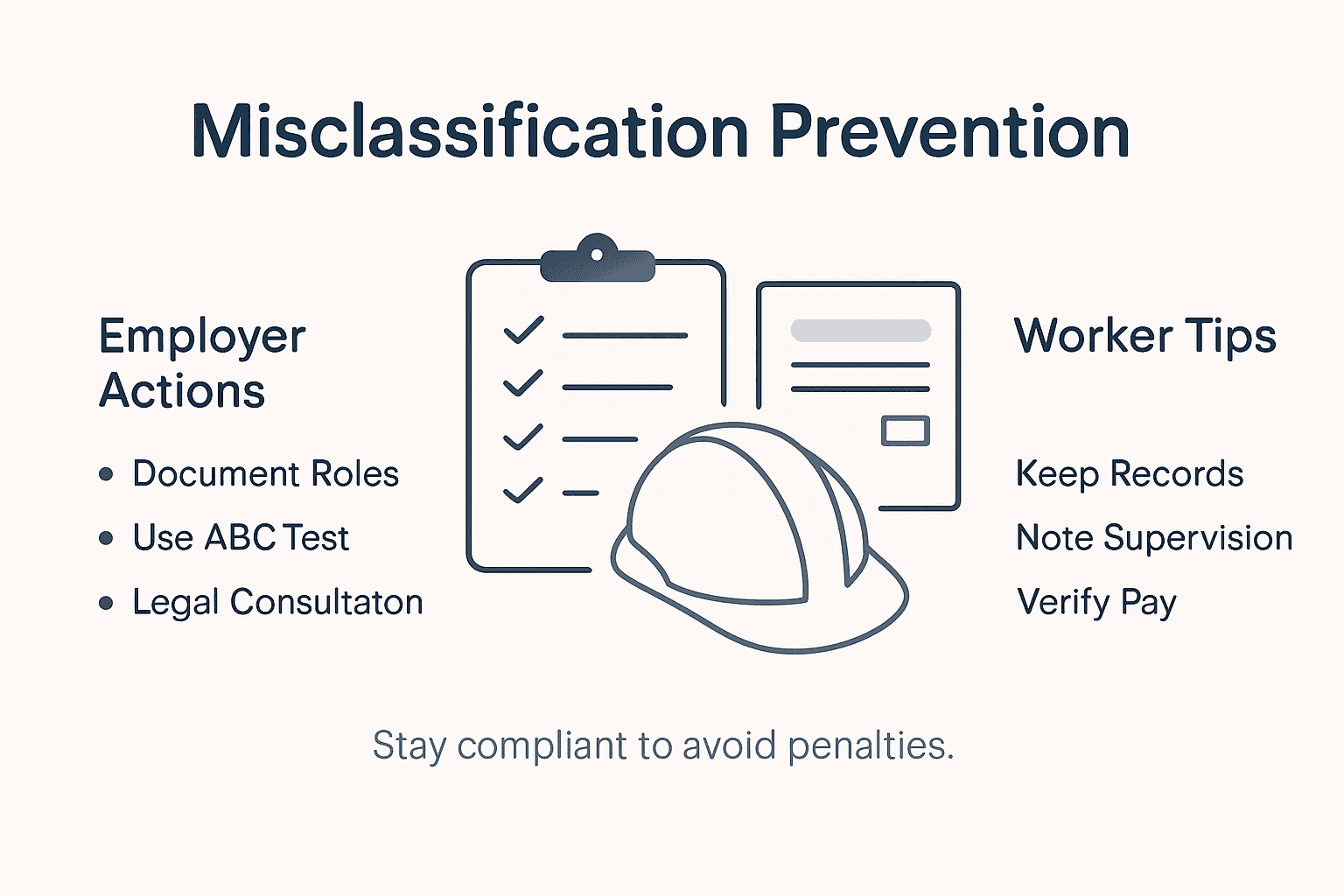
Pro Tip: Develop a comprehensive internal checklist that systematically evaluates worker status using the ABC test criteria before finalizing any independent contractor engagement.
Protect Your Rights Against Contractor Misclassification in Garden Grove
Misclassification of contractors creates serious challenges for both workers and construction firms in Garden Grove. If you suspect you have been wrongly classified as an independent contractor instead of an employee, you may be missing out on vital protections like overtime pay, workers compensation, and unemployment benefits. The complex ABC Test and new 2026 legal requirements make it easy for employers to unintentionally or deliberately misclassify workers, putting you at risk of lost wages and legal confusion.
At Serendib Law Firm, we understand how stressful these issues can be and are committed to helping you navigate the tough legal landscape. Whether you are an individual worker unsure of your rights or a business seeking guidance on compliance, our experienced team offers personalized advocacy to protect your interests. Start by learning more about your situation through our Misclassification Archives and find local support via our Garden Grove Archives.
Do not wait until penalties or lost wages stack up. Visit Serendib Law Firm today to schedule a free consultation and take the vital step toward resolving misclassification risks with trusted legal support.
Frequently Asked Questions
What is contractor misclassification in construction?
Contractor misclassification in construction occurs when workers are improperly classified as independent contractors instead of employees, impacting their rights and benefits.
How does California’s ABC Test determine worker status?
California’s ABC Test requires employers to prove three conditions to classify a worker as an independent contractor: freedom from control, tasks outside usual business operations, and independent establishment in a similar trade.
What are the penalties for misclassifying workers in California?
Employers can face penalties ranging from $5,000 to $25,000 for each classification violation, along with potential liabilities for unpaid wages and taxes.
What are best practices for avoiding contractor misclassification?
To avoid misclassification, construction firms should conduct regular audits, maintain detailed documentation of working relationships, and train management on the criteria of the ABC Test.
Recommended
- Experienced Garden Grove Employment Law Attorneys
- Complete Guide to Whistleblower Laws in Garden Grove | Serendib Law Firm
- Experienced Garden Grove Workplace Discrimination Lawyers
- Fountain Valley Case Study: Contractor vs. W-2 Staff
- Form ss-8 | Payroll Tax Employer vs Employee
https://www.serendiblaw.com/misclassification-of-contractors-garden-grove/?fsp_sid=330


Comments
Post a Comment