Retaliation After Reporting Harassment in Santa Ana Offices

Retaliation can feel like a quiet shift in how you are treated at work rather than a sudden, obvious act. For those in Santa Ana government offices, reporting harassment or discrimination is a protected activity under California law, yet the fear of punishment remains real. Understanding workplace retaliation is illegal and learning how to recognize, document, and respond to it empowers you to protect your rights and seek the support you deserve.
Table of Contents
- Defining Retaliation in Santa Ana Government Offices
- Types of Retaliatory Actions Employees May Face
- Legal Protections for Whistleblowers and Victims
- Steps to Take if Retaliation Occurs
- Common Pitfalls and What to Avoid
Key Takeaways
| Point | Details |
|---|---|
| Understanding Retaliation | Retaliation occurs when employers act against employees for reporting harassment or illegal conduct, not just through termination. Various subtle forms can constitute retaliation, requiring awareness and documentation. |
| Legal Protections | California law protects employees from retaliation for reporting workplace violations, ensuring there are multiple legal recourses available for employees who experience retaliation. |
| Document Everything | Immediate documentation of incidents is critical for proving retaliation claims, including dates, times, and specifics of the retaliatory actions. |
| Consult an Attorney | Seeking legal advice promptly is essential to navigating retaliation claims and understanding one’s rights and options for recourse effectively. |
Defining Retaliation in Santa Ana Government Offices
Retaliation in the workplace isn’t always obvious. You might expect a dramatic termination, but that’s only one form it takes. In Santa Ana government offices, retaliation happens when your employer takes action against you specifically because you reported harassment, discrimination, or other illegal conduct. The action itself doesn’t need to be catastrophic to qualify as retaliation. A schedule change, a delayed promotion, reduced hours, a negative performance review that contradicts your previous evaluations, exclusion from meetings, or even hostile comments from supervisors all count as adverse actions. What ties these diverse situations together is the employer’s motivation. They’re punishing you for doing something the law protects you from doing.
California law is clear on this point. Workplace retaliation is illegal when employers punish employees for engaging in legally protected activities. For government employees in Santa Ana, this protection extends to reporting harassment, discrimination, wage violations, unsafe working conditions, or violations of public policy. The law doesn’t care whether you reported the problem internally through your agency’s HR department, to a government agency, or directly to your supervisor. It also doesn’t matter whether your complaint turned out to be completely accurate or even if the employer ultimately found no wrongdoing. The act of reporting is what’s protected. If your employer then disciplines you, fires you, demotes you, or makes your work life significantly worse, that’s retaliation, and it’s illegal. This applies to Santa Ana government offices with five or more employees, which means virtually all municipal departments fall under this protection.
Proving retaliation requires establishing three key elements. First, you must show you engaged in a protected activity, meaning you reported harassment, discrimination, or violated a public policy. Second, you suffered an adverse work action that a reasonable person would find materially unfavorable. Third, and this is crucial, there must be a connection between your protected activity and the adverse action. Timing matters here. If you reported harassment on Monday and received a written warning on Tuesday for something you’d been doing for months without complaint, that’s a red flag suggesting retaliation. Employers sometimes try to justify adverse actions with pretextual reasons. They might claim you were fired for poor performance when the documentation shows you received positive evaluations before your complaint. In Santa Ana government offices, where records tend to be detailed and accessible, these inconsistencies become easier to demonstrate. Understanding whether retaliation claims require specific legal procedures can help you understand your options for protection and recovery.
Pro tip: Start documenting everything the moment you realize retaliation might be occurring, including dates, times, witness names, and what specifically happened. Save all emails, performance reviews, and communications that show the change in how you’re being treated, as this timeline becomes critical evidence if you need to pursue a legal claim.
Types of Retaliatory Actions Employees May Face
Retaliation doesn’t announce itself. It doesn’t come with a memo stamped “This is punishment for your harassment complaint.” Instead, it disguises itself in the ordinary machinery of workplace decisions. Understanding the forms retaliation takes is critical because many Santa Ana government employees don’t recognize what’s happening to them until the pattern becomes undeniable. Termination is the most obvious form, but it’s actually just one of many ways employers retaliate. A manager might fire you outright, but more commonly, retaliation takes subtler shapes that are harder to connect to your complaint. You might face a sudden denial of a promotion you’d been promised, a reassignment to a less desirable position, a reduction in your work hours, or elimination of your shift flexibility that previously existed. Some employers demote employees who complain, stripping them of supervisory responsibilities or placing them in lower-paying roles. These employment actions all qualify as retaliatory if they’re connected to your protected complaint.
Beyond direct employment actions, retaliation often manifests in how you’re treated day-to-day at work. Your supervisor might exclude you from meetings you normally attend, withhold information you need to do your job effectively, or reassign your best projects to other employees without legitimate explanation. Written reprimands and negative performance reviews represent another common retaliation tactic, especially when these documents suddenly appear after years of positive evaluations. In Santa Ana government offices, the paper trail around these reviews becomes crucial evidence because agencies maintain detailed personnel files. Some employers impose new rules or enforce existing policies selectively, targeting only the employee who complained. You might face increased scrutiny of your work, mandatory overtime, or scheduling changes that disrupt your life. Wage-related retaliation includes salary freezes, elimination of bonuses or benefits, or refusal to provide pay increases given to comparable employees. Hostile work environment retaliation occurs when supervisors or coworkers, sometimes with implicit encouragement from management, make your workplace intentionally uncomfortable through unwelcome comments, exclusion from team activities, or public criticism. Understanding various forms of workplace retaliation helps you recognize what might otherwise seem like isolated incidents.
The most damaging retaliation often involves threats and intimidation. Supervisors might threaten to fire you if you pursue legal action, warn you that you’ll never work in government again, or suggest your career is over if you don’t drop your complaint. Some employers fabricate performance problems or manufacturing policy violations as pretexts for discipline. They document everything about your work suddenly, then selectively discipline only you for minor infractions. Transfer requests get mysteriously denied, training opportunities disappear, and your contributions go unrecognized in meetings where they’d previously been acknowledged. In some cases, retaliation extends to your benefits. An employer might suddenly challenge your eligibility for family medical leave, deny previously approved time off, or terminate your health insurance coverage. Creating an intolerable work environment through retaliation is a deliberate strategy to force you to resign voluntarily, which employers hope will complicate any future legal claim. The timing of these actions is telling. When adverse employment decisions cluster immediately after you file a harassment complaint or participate in an investigation, courts recognize this as powerful evidence of retaliation.

Pro tip: Keep a detailed personal calendar noting every retaliatory action, no matter how small it seems, along with dates, times, who was involved, and exactly what happened or was said, because even seemingly minor incidents create a pattern that strengthens your legal case.
Legal Protections for Whistleblowers and Victims
You have rights. Real, enforceable rights that protect you when you report harassment or illegal conduct in Santa Ana government offices. California law does not leave victims vulnerable to retaliation. The state has built multiple layers of legal protection into its employment law framework, specifically designed to shield employees who speak up. These protections exist because lawmakers recognized that retaliation silences complaints and perpetuates workplace abuse. If your employer punishes you for reporting harassment, discrimination, or other violations, you have legal recourse. Understanding what protections apply to you is the first step toward defending yourself.
California’s anti-retaliation statutes form the foundation of your legal shield. The primary protection comes from Labor Code Section 1102.5, which protects employees who report violations of law to government agencies or internally to their employer. This means you are protected whether you reported harassment to your supervisor, your agency’s HR department, the California Department of Fair Employment and Housing, or any other government body. The law also protects employees who file complaints, testify, or participate in investigations related to workplace violations. Whistleblower protections in Santa Ana extend to many types of disclosures, including reports of harassment, discrimination based on protected characteristics, wage violations, unsafe working conditions, and violations of public policy. For government employees specifically, additional protections may apply under civil service rules and public employee protections. The breadth of this coverage means most forms of legitimate reporting are protected. Your employer cannot fire you, demote you, reduce your pay, or take any other adverse action because you reported wrongdoing.
Beyond statutory protections, California recognizes several additional legal doctrines that protect employees. The implied covenant of good faith and fair dealing prevents employers from retaliating against employees in a manner that breaches the employment relationship. Tort law provides remedies for intentional infliction of emotional distress and other wrongful acts. Many Santa Ana government employees also have protections under civil service laws and union agreements, which impose strict procedural requirements on discipline and termination. If your employer violated these protections through retaliation, you can pursue legal remedies. These include recovering back pay and lost benefits, front pay for future earnings, compensatory damages for emotional distress and harm to your reputation, punitive damages when retaliation was willful and malicious, and in some cases, attorney fees and costs. Reinstatement to your former position is also available when appropriate. Government employers sometimes face additional liability under federal civil rights laws if retaliation involves discrimination or relates to protected conduct under federal whistleblower statutes.
The practical reality is that proving retaliation gives you leverage. Employers know the liability exposure is significant. Once you establish that you engaged in protected activity and suffered an adverse action connected to that activity, the burden shifts to your employer to prove they would have taken the same action regardless of your complaint. This burden shift is powerful because it forces employers to produce evidence that contradicts their pretextual justifications. In many retaliation cases against Santa Ana government agencies, the detailed personnel records actually work against the employer. Suddenly imposed rules, inconsistent enforcement, documentation that appears overnight, and timing that aligns suspiciously with your complaint all create a compelling narrative of retaliation. The law recognizes that employers rarely admit their true motivation, so courts look at the pattern and context of events.
Here is a summary of key legal protections and remedies available to Santa Ana government whistleblowers:
| Legal Protection Source | Who Is Covered | What It Protects Against | Remedies Available |
|---|---|---|---|
| CA Labor Code § 1102.5 | All government employees | Retaliation for reporting illegal conduct | Reinstatement, back pay, damages |
| FEHA (Fair Employment and Housing Act) | Employees reporting discrimination | Retaliation after discrimination complaints | Emotional distress, punitive damages |
| Civil Service Rules | Civil service/public employees | Unlawful adverse job actions | Job restoration, procedural review |
| Union Agreements | Unionized employees | Retaliation, discipline outside agreements | Arbitration, grievance procedures |
| Federal Whistleblower Statutes | Employees reporting federal issues | Retaliation for protected disclosures | Back pay, attorney fees, damages |
Pro tip: Report your complaint in writing whenever possible, and keep copies of all written communications about the harassment and your complaint, as this creates an undeniable record of when you reported and what you reported, which is essential to proving retaliation occurred.
Steps to Take if Retaliation Occurs
The moment you suspect retaliation, your instinct might be to panic or stay silent. Fight that instinct. Taking the right steps immediately after retaliation begins can mean the difference between a weak case and a strong one. The most critical action is documenting everything that happens. Start recording dates, times, what occurred, who was involved, and any witnesses. Write down exact quotes if someone made threats or hostile comments. Save every email, text message, and written communication related to your complaint or the retaliatory actions. Take screenshots of messages before they disappear. If your supervisor made verbal threats, write a memo to yourself that same day describing what was said and who heard it. This contemporaneous documentation is gold in a retaliation case because it shows you were paying attention and keeping records in real time, not reconstructing events months later from memory. Store copies of these records outside your workplace, such as on personal email or cloud storage, so your employer cannot delete them.
Your next step is to report the retaliation through formal channels. If your Santa Ana government agency has an internal retaliation or harassment complaint process, use it. File a written complaint with your HR department or the designated agency office, clearly stating that you are experiencing retaliation for your previous harassment complaint. Keep a copy of this complaint and get a dated receipt showing you filed it. After filing internally, you have the option to file a complaint with external government agencies. The California Labor Commissioner’s Office enforces retaliation protections and can investigate your complaint. You can also file with the California Department of Fair Employment and Housing if your retaliation involves discrimination. Filing these complaints creates an official record and triggers an investigation. Government investigators have subpoena power, can compel witness testimony, and can access your employer’s records and policies. They can also issue cease-and-desist orders requiring your employer to stop retaliatory conduct immediately. The agency’s findings can support your case if you later pursue legal action. Timing matters here. File your complaint as soon as retaliation begins or shortly thereafter. Delays in reporting can affect the strength of your claim.
Consider consulting an employment attorney before taking major steps. An experienced retaliation lawyer can review the facts of your situation, explain your legal options, and advise you on the best course of action. Some attorneys offer free consultations, so you can get professional guidance without financial commitment. An attorney can also help you draft a more powerful complaint to the Labor Commissioner and can represent you throughout the investigative process. In many cases, simply knowing you have legal representation encourages employers to stop retaliatory behavior or settle the matter favorably. If your employer is a Santa Ana government entity, certain procedural requirements may apply, such as filing administrative complaints before pursuing litigation. An attorney familiar with public employment law can ensure you follow these procedures correctly and preserve your legal rights. Do not feel pressured to resign or accept a settlement without legal advice. Some employers attempt to force employees out or pressure them into signing away their rights. Your attorney can protect your interests and ensure any agreement truly compensates you for the harm you have suffered.
When Retaliation Intensifies
If retaliation escalates despite your complaints, your attorney can send a formal letter to your employer documenting the retaliation and demanding it cease. This letter puts your employer on notice that you know your rights and are prepared to pursue legal action. Many employers change course when they realize you are serious. If retaliation continues, you may pursue litigation or demand arbitration if your employment agreement requires it. You can seek damages including back pay, lost benefits, compensatory damages for emotional distress, and in some cases, punitive damages designed to punish willful retaliation. An attorney can also ensure you preserve evidence and comply with legal requirements that protect your case.
Pro tip: Keep a separate notebook or digital file exclusively for retaliation documentation, and update it immediately after each incident while details are fresh, because a consistent, detailed record defeats employer attempts to claim you are exaggerating or misremembering events.
Common Pitfalls and What to Avoid
When you are experiencing retaliation, your judgment can become clouded by anger, fear, and frustration. This emotional state is completely understandable, but it is precisely when you are most vulnerable to making mistakes that damage your case. The first and most costly pitfall is failing to document retaliation in real time. Employees often assume they will remember details later or believe that what is happening is so obvious that documentation will not matter. Then months pass, memories fade, and suddenly you cannot recall exact dates or what was specifically said. Your employer, meanwhile, has carefully documented their version of events. Do not fall into this trap. Write things down immediately. The second major mistake is discussing your retaliation openly with coworkers, on social media, or in public settings. While venting feels good temporarily, you are creating a record that your employer can use against you. Your employer will claim you were disgruntled, unprofessional, or spreading false information. They will point to your social media posts or gossip as evidence that any performance issues or discipline were justified. Keep your situation confidential. Share details only with people who need to know: your attorney, your HR department in formal complaints, and trusted family members. The third pitfall is resigning before consulting an attorney. Many employees under intense retaliation pressure decide to quit. They believe leaving the situation will relieve the stress. What they do not realize is that resignation often kills their retaliation claim. Your employer will argue you voluntarily left, so they never had the chance to continue retaliating. You have lost leverage and your claim becomes much weaker. If retaliation is making your job genuinely unbearable, consult an attorney first about your options. Sometimes staying while building your case is the stronger strategy.
Another critical mistake is accepting a severance package or settlement offer without legal review. Your employer may approach you with what sounds like a generous severance package, but buried in that agreement is typically a clause requiring you to waive your right to sue for retaliation. You are trading away your legal claims for cash. Without an attorney reviewing the terms, you cannot understand what you are giving up. Many severance agreements also include non-disparagement clauses that prevent you from discussing the retaliation publicly or even with future employers. Do not sign anything without having your attorney review it first. Employers often present these documents as final and non-negotiable, but that is rarely true. Your attorney can negotiate better terms. Failing to report retaliation formally is another pitfall that weakens your position. Some employees report harassment initially but then stay silent about retaliation because they are discouraged or afraid of further consequences. Your employer counts on this silence. Formal complaints to HR and government agencies create official records that courts recognize as credible. Informal complaints or conversations do not carry the same weight. Report retaliation just as formally as you reported the original harassment. File written complaints with HR. File complaints with the California Labor Commissioner or Fair Employment and Housing Department. Create a paper trail that shows you took the retaliation seriously and pursued proper channels.
Ignoring deadlines and procedural requirements is a mistake that can cost you your entire case. Different agencies and different types of claims have specific filing deadlines. While there are applicable statute of limitations that should be evaluated on a case by case basis, missing internal agency deadlines or external agency deadlines can bar your claim entirely. Some employers require you to exhaust internal remedies before filing external complaints. Some government agencies have specific procedures for public employees. An attorney familiar with workplace retaliation claims in Santa Ana can ensure you comply with all procedural requirements and meet all deadlines. Finally, avoid continuing to perform poorly at work or engaging in actual misconduct as a response to retaliation. Your employer will use genuine performance problems against you. If you are being retaliated against, your instinct might be to stop caring about your job. Resist that instinct. Continue performing your duties competently. If your employer is manufacturing documentation of poor performance, good work habits create a contrast that exposes their pretext. If you actually engage in misconduct, your employer has legitimate grounds for discipline that have nothing to do with retaliation.
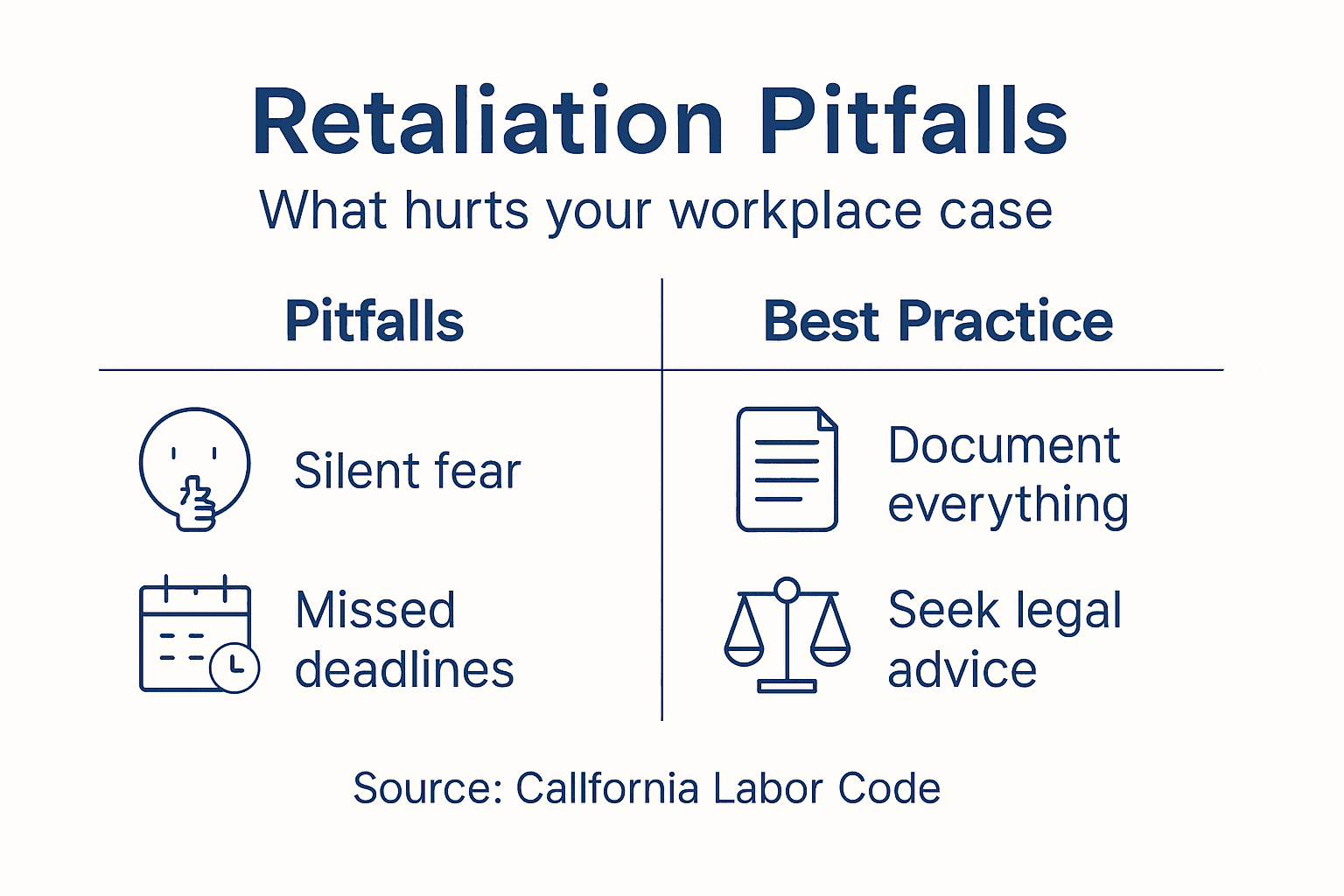
The following table compares common pitfalls during retaliation cases with recommended best practices:
| Pitfall to Avoid | Why It Harms Your Case | Best Practice Instead |
|---|---|---|
| Not documenting events | Fades memory, loses key evidence | Record dates, quotes, and witnesses |
| Discussing with coworkers or online | Employer may use it against you | Limit sharing to attorney, HR, or family |
| Resigning without legal advice | Reduces claim leverage | Consult an attorney before leaving |
| Signing documents blindly | May waive your rights | Have an attorney review all agreements |
| Missing complaint deadlines | Can bar claims completely | Track deadlines and file promptly |
The Silence Trap
Many retaliated employees suffer in silence, hoping the retaliation will stop if they just keep quiet and do their job. It does not. Retaliation typically escalates when employees do not resist. Your silence signals to your employer that they can continue without consequences. Speaking up, filing complaints, and seeking legal counsel are not weaknesses. They are how you protect yourself.
Pro tip: Before taking any major action regarding your retaliation case, write down your plan and review it with an employment attorney, even if just in a brief consultation, to catch mistakes that could harm your legal position before you make them.
Protect Yourself from Retaliation After Reporting Harassment in Santa Ana Government Offices
Facing retaliation after reporting workplace harassment is an overwhelming challenge that can leave you feeling isolated and powerless. This article shows how retaliation can take many subtle forms such as demotions, negative evaluations, or exclusion from important meetings all designed to punish you for exercising your legal rights. If you are dealing with this stressful situation, you need experienced legal advocates who understand the complexities of retaliation claims and the protections available to Santa Ana government employees.
At Serendib Law Firm, we specialize in defending employees against unlawful retaliation and harassment. Our dedicated team will help you document and prove retaliation while navigating internal complaint procedures and government investigations. Visit our Retaliation Archives to learn more about your rights. If you are facing retaliation specifically in Santa Ana, explore insights from our Santa Ana Archives to see how local laws and rules apply to your case. Do not wait for retaliation to escalate or become permanent. Take control of your situation by contacting Serendib Law Firm today at https://www.serendiblaw.com/.
Schedule a free consultation to get personalized advice and strong legal representation that fights for your rights and ensures that retaliation stops now.
Frequently Asked Questions
What constitutes retaliation in the workplace?
Retaliation occurs when an employer takes adverse action against an employee specifically because the employee reported harassment, discrimination, or other illegal conduct. This can include things like changes in schedule, reduced hours, negative performance reviews, or even termination.
How can I prove that I experienced retaliation after reporting harassment?
To prove retaliation, you must demonstrate three elements: you engaged in a protected activity (like reporting harassment), suffered an adverse employment action (that a reasonable person would find unfavorable), and there is a clear connection between your complaint and the adverse action.
What should I do if I believe I am facing retaliation?
If you suspect retaliation, begin documenting everything related to the incidents. Report the retaliation formally through your agency’s HR department and consider consulting an employment attorney for guidance on your rights and next steps.
What legal protections do I have against workplace retaliation?
California law provides strong protections against retaliation for employees who report illegal conduct. Under Labor Code Section 1102.5, employees cannot be punished for reporting violations to government agencies or for participating in investigations related to workplace misconduct.
Recommended
- Experienced Santa Ana Workplace Retaliation Lawyers
- Public-Policy Retaliation: Santa Ana Employee Rights
- Experienced Santa Ana Workplace Harassment Lawyers
- Whistleblower Protections in Santa Ana After Corruption Cases | Serendib Law Firm
- PALM BEACH COUNTY SHERIFF’S OFFICE LAUNCHES “SAFE PLACE” INITIATIVE TO COMBAT HATE CRIMES - Luxury Apartments for Rent in Boca Raton | Premium Boca Raton Apartments | Aapartments Boca Raton
https://www.serendiblaw.com/retaliation-workplace-harassment-santa-ana/?fsp_sid=360


Comments
Post a Comment