Layoffs at Rivian: When WARN Act Protections Matter

Losing a job at a major California tech company like Rivian can be overwhelming, especially when layoffs seem sudden and unclear. Understanding your rights under the WARN Act is crucial, since this federal law requires employers with 100 or more employees to provide 60 days advance notice before plant closings or mass layoffs affecting 50 or more workers. This guide explains what triggers WARN Act protections, the key requirements employers must follow, and how you can recognize if your rights were violated during a termination.
Table of Contents
- What Triggers WARN Act Protections
- Types of Layoffs Covered by the WARN Act
- Key WARN Act Requirements for Tech Employers
- Employee Rights and Company Obligations
- Common Exceptions and Next Steps
Key Takeaways
| Point | Details |
|---|---|
| Employee Count Requirement | The WARN Act applies only if the employer has at least 100 employees companywide. Smaller businesses are exempt. |
| Layoff Size and Timing | The law is triggered by layoffs affecting 50 or more employees at a single site or 500 across multiple sites, aggregated over a 90-day period. |
| 60-Day Notice Obligation | Employers must provide 60 days advance notice in writing before layoffs occur, specifying details about the job losses. |
| Exceptions to the Rule | Narrow exceptions apply for unforeseeable events, but these are rarely accepted and require substantial evidence. |
What Triggers WARN Act Protections
The WARN Act doesn’t apply to every layoff. Understanding what actually triggers the law’s requirements is critical for employees facing job loss at companies like Rivian.
Rivian and similar tech companies operate under strict federal rules. The WARN Act kicks in only when specific conditions are met simultaneously.
The Employee Count Threshold
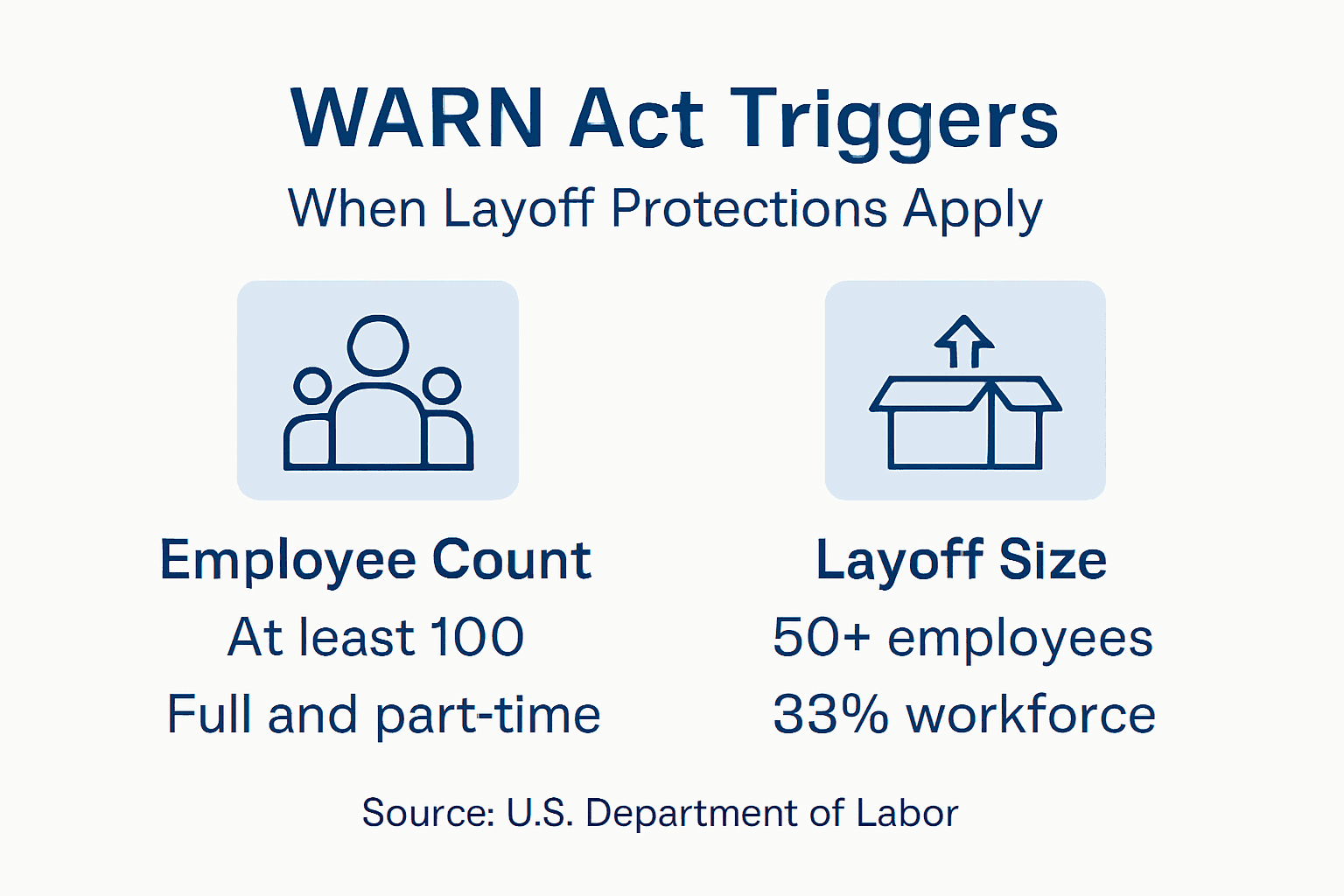
Your employer must have at least 100 employees on the payroll for the law to apply. This includes full-time and part-time workers across all company locations.
Rivian currently exceeds this threshold significantly. The company employs thousands of workers across multiple facilities.
Smaller operations don’t trigger WARN protections. A startup with 75 employees laying off half its workforce wouldn’t require WARN notices.
The Layoff Size Requirement
Plant closures or mass layoffs affecting at least 50 employees within a single site trigger the law. This is the second critical threshold.
Your company’s financial situation doesn’t matter. The law applies regardless of profit or loss.
Here’s what counts as an employment loss:
- Involuntary terminations without cause
- Layoffs lasting more than six months
- Work hour reductions exceeding 50 percent for six consecutive months
- Positions eliminated through plant closure
Rivian’s recent workforce reductions involved significant layoffs across multiple locations. These likely triggered WARN Act obligations at affected sites.

The 90-Day Aggregation Rule
Layoffs don’t need to happen all at once. The law counts multiple reductions aggregated over 90 days as a single triggering event.
Imagine Rivian cuts 30 employees in January, 25 in February, and 20 in March. These three separate waves add up to 75 employees within 90 days, triggering WARN requirements.
Employers sometimes try spacing layoffs strategically to avoid WARN notice requirements. Courts and the Department of Labor watch for this tactic.
When WARN Doesn’t Apply
The law includes narrow exceptions. Your company can skip the 60-day notice for:
- Unforeseeable circumstances like sudden customer loss or market collapse
- Natural disasters causing immediate shutdowns
- Faltering company status when the employer is actively seeking funding to prevent closure
These exceptions are genuinely rare. Employers need substantial evidence proving they couldn’t foresee the layoff.
Know the exact date your employer announced or executed layoffs. This determines whether WARN requirements applied and affects your legal timeline.
Putting It Together
For WARN Act protections to apply at your company, all three factors must exist:
- Employer has 100 or more employees
- Layoff affects 50 or more employees at a single site (or 500 across multiple sites)
- No legitimate exception applies
Rivian meets all three conditions. If you received less than 60 days’ notice before your termination or the company failed to notify you at all, you may have a WARN Act violation claim.
Pro tip: Document the exact date you learned about the layoff and when your employment actually ended. This timeline is essential for any WARN Act claim and determines whether the company violated the 60-day notice requirement.
Here’s a quick reference table summarizing what triggers WARN Act protections:
| Factor | What It Means | Why It Matters |
|---|---|---|
| Employee Count | At least 100 employees companywide | Smaller businesses are exempt |
| Layoff Size | 50+ employees at one site, or 500+ total | Large-scale losses trigger notice |
| Timing | Layoffs within a 90-day period are aggregated | Prevents employers from splitting layoffs to avoid the law |
| Exceptions | Rare, must meet strict criteria | Only genuine unforeseen events qualify |
Types of Layoffs Covered by the WARN Act
Not every job loss qualifies for WARN Act protection. The law is specific about which types of layoffs trigger the 60-day notice requirement.
Understanding what counts helps you know whether your employer violated the law when they let you go.
Plant Closings
A plant closing occurs when an employer shuts down a work site permanently or temporarily. The facility stops operating, affecting all or substantially all employees at that location.
This includes manufacturing plants, office locations, warehouses, and research facilities. The closure must result in employment loss for at least 50 employees.
Rivian’s facility closures or production line shutdowns would qualify. Even temporary shutdowns lasting more than six months trigger WARN requirements.
Mass Layoffs
Mass layoffs affecting 50 or more employees trigger WARN protections without a plant closing. The employer continues operating but eliminates positions.
There are two types of qualifying mass layoffs:
- Layoffs affecting 500 or more employees at a single site
- Layoffs affecting 50 to 499 employees that represent at least 33 percent of the workforce
Rivian’s workforce reductions involved significant percentage cuts across multiple facilities. These likely met the mass layoff threshold.
The 33 Percent Threshold Explained
If your employer has 200 employees and eliminates 67 jobs, that’s 33.5 percent of the workforce. The layoff triggers WARN even though it’s under 500 people.
Smaller percentage cuts don’t trigger the law. Eliminating 25 positions at a 200-person company (12.5 percent) wouldn’t qualify.
This rule catches companies trying to avoid WARN by laying off smaller percentages repeatedly.
Work Hour Reductions
Significant reductions in work hours for six consecutive months also count as employment loss. A 50 percent or greater reduction triggers protections.
Imagine your employer cuts everyone’s hours from 40 to 20 per week for six months. You’ve experienced employment loss even though you weren’t officially terminated.
Temporary reductions don’t count. The reduction must last half a year or longer.
Extended Layoff Periods
Layoffs lasting more than six months qualify for WARN protection. Your employer can’t avoid notice requirements by calling a termination “temporary.”
The law assumes longer layoffs are permanent employment losses.
Whether your layoff involves a plant closure, mass reduction, or hours cut, the key is timing—WARN protections apply when 50 or more employees experience employment loss within a 30-day period.
Real-World Scenario
Rivian announced multiple layoff rounds affecting thousands of employees. These reductions across multiple sites involved:
- Permanent elimination of positions
- Facility consolidations
- Significant workforce percentage cuts
All three characteristics suggest WARN Act obligations applied.
Pro tip: Identify which type of layoff affected you—plant closure, mass layoff, or hours reduction—because this classification determines your legal timeline and which offices received notice requirements.
Compare the types of workforce actions that can trigger WARN Act notice:
| Action Type | Triggers WARN? | Key Criteria |
|---|---|---|
| Plant Closing | Yes | Permanent/temporary site closure, 50+ jobs lost |
| Mass Layoff | Yes | 50+ jobs lost and 33% of site, or 500+ |
| Work Hour Reduction | Yes | 50%+ reduction for 6+ months |
| Short-Term Layoff | No | Less than 6 months duration |
Key WARN Act Requirements for Tech Employers
When tech companies like Rivian face layoffs, federal law imposes specific obligations on employers. Understanding these requirements helps you recognize whether your company violated the law.
These rules apply to tech firms across California and the entire United States.
The 60-Day Notice Requirement
Employers must provide 60 days advance notice before triggering events occur. This is the cornerstone of WARN Act protection.
The notice period starts from the day the employer announces the layoff or plant closure. Employees must receive written notification at least 60 days before employment ends.
Rivian’s layoff announcements should have been followed by 60 days of continued employment or severance protection.
Who Gets Notified
Employers must notify affected employees in writing about pending layoffs. The notification process extends beyond just telling people they’re fired.
Required notifications include:
- Affected employees (individually)
- Employee representatives or unions
- State dislocated worker units
- Local government officials in affected areas
Skipping any of these groups violates WARN requirements. Tech companies operating in multiple states must notify officials in each jurisdiction.
Written Notice Requirements
Notices must be detailed and in writing. Verbal announcements don’t satisfy WARN requirements.
Proper notices should specify:
- Expected date of layoff or plant closing
- Whether the closure is permanent or temporary
- Job titles affected
- Expected number of employees losing jobs
- Any bumping or transfer rights
Vague company-wide emails lack sufficient detail. Rivian’s official layoff announcements should have included these specific elements.
Coordination With Government Agencies
Employers must work with local workforce development boards and state agencies. This coordination helps affected workers access retraining and unemployment benefits.
Tech companies can’t simply announce layoffs independently. Government notification requirements are mandatory, not optional.
Threshold Determination
Mass layoff determinations require careful calculation of employee numbers and percentages. Companies must honestly assess whether thresholds are met.
This includes:
- Counting all 100 or more employees on payroll
- Determining if 50 or more will lose employment
- Calculating percentage impact on workforce
- Identifying whether 33 percent threshold applies
Cutting corners or misclassifying layoffs violates the law.
Exception Documentation
If employers claim exceptions for unforeseeable circumstances, they must document the evidence thoroughly. Generic claims don’t excuse notice failures.
Companies must prove sudden market collapse, unexpected business loss, or genuine catastrophic events.
Tech employers cannot use financial difficulties, strategic decisions, or planned restructurings as exceptions to WARN requirements—the law specifically covers these situations.
Real-World Application
Rivian’s recent layoffs involved thousands of employees. The company was required to provide 60 days’ notice, notify all affected workers in writing, and coordinate with state and local agencies.
Failure to follow these steps created potential legal liability.
Pro tip: Collect all layoff communications from your employer—email announcements, termination letters, severance offers—because these documents prove whether the company provided proper 60-day written notice as required by law.
Employee Rights and Company Obligations
When your employer violates the WARN Act, you have legal protections and remedies. Understanding your rights empowers you to take action if Rivian or another tech company cuts corners.
The law exists specifically to protect employees like you from sudden job loss without warning.
Your Right to 60 Days Advance Notice
You have an absolute right to 60 days advance written notice before employment ends due to layoffs or plant closure. This isn’t a suggestion—it’s a federal requirement.
Employers must deliver written notice including reasons for layoff, specific dates, and affected job titles. Verbal announcements don’t count. Generic company emails without specific details don’t satisfy the requirement.
Rivian owed departing employees clear, detailed written notification 60 days before their jobs disappeared.
Notice Content Requirements
Your notice must include critical information:
- Specific effective date of the layoff
- Whether closure is permanent or temporary
- Your job title and department
- Expected number of affected employees
- Severance eligibility and continuation coverage details
Missing elements make the notice inadequate. Vague timelines like “sometime next quarter” don’t meet legal standards.
Right to Legal Recourse
Workers can seek legal recourse if notices are not given properly. You’re not powerless if your employer violated WARN requirements.
You may be entitled to:
- Back pay and benefits for the 60-day notice period
- Damages for emotional distress and financial hardship
- Attorney’s fees and court costs
- Liquidated damages equal to lost pay
These remedies exist to make employers take WARN obligations seriously.
Company Obligations to Multiple Parties
Your employer must notify more than just you. Required notifications extend to:
- Your union representative or employee committee
- State dislocated worker agencies
- Local government officials where you work
- Workforce development boards
Failure to notify any required party violates the law. Companies can’t pick and choose who gets notified.
Right to Transition Assistance
Employers must facilitate rapid response strategies to help you find new work. This includes coordination with government retraining programs and job placement services.
Your company can’t simply cut you loose and disappear. Legal obligations include supporting your transition.
Right to Information About Benefits
Notices must clearly explain health insurance continuation coverage (COBRA), pension vesting, and severance eligibility. You deserve complete information about your benefits.
Your employer’s obligation to provide proper WARN notice isn’t optional, discretionary, or negotiable—it’s a hard legal requirement with serious penalties for violations.
Real-World Application at Rivian
Rivian’s large-scale layoffs triggered WARN Act obligations to thousands of employees. The company was legally required to provide 60 days advance notice, detailed information, and coordination with government agencies.
Employees who received less notice or incomplete information may have strong legal claims.
Pro tip: If you didn’t receive a detailed written notice at least 60 days before your layoff date, keep records of when you learned about the termination and gather any written communications from your employer, as these form the basis of your WARN Act claim.
Common Exceptions and Next Steps
The WARN Act isn’t absolute. Employers can claim narrow exceptions, but they rarely hold up in court. Understanding these exceptions and knowing your next steps protects your legal interests.
Most companies trying to avoid WARN obligations will fail under legal scrutiny.
Unforeseeable Business Circumstances
Employers can skip the 60-day notice if they face unforeseeable business circumstances beyond their reasonable control. This exception is extremely narrow.
What qualifies:
- Sudden, unexpected loss of major customer or contract
- Unexpected business failure or bankruptcy
- Sudden catastrophic event affecting operations
- Unexpected market collapse
What doesn’t qualify:
- Financial difficulties the company anticipated
- Strategic business decisions to downsize
- Planned restructuring or pivot
- Foreseeable market trends
Rivian’s financial challenges were widely known before layoff announcements. Claiming unforeseeability would be unconvincing.
The Faltering Company Exception
Faltering company situations allow exceptions if specific conditions are met. A company must be actively seeking funding to avoid closure.
Requirements include:
- Company was actively seeking new capital or financing
- Good faith belief that advance notice would jeopardize funding
- Actual diligent efforts to obtain necessary capital
Passively hoping for investment doesn’t count. Companies must prove aggressive, documented fundraising efforts.
Natural Disasters
True natural disasters—earthquakes, hurricanes, floods, wildfires—can exempt employers from advance notice. The disaster must cause immediate, unavoidable facility closure.
The exception applies only to affected locations. Nationwide layoffs can’t be justified by regional disasters.
Notice Requirements When Exceptions Apply
Employers must provide notice as soon as practicable even when claiming exceptions. They can’t remain silent indefinitely.
Notifications must include a brief explanation of why advance notice wasn’t possible. Courts scrutinize these explanations carefully.
Your Next Steps If WARN Was Violated
If you received inadequate notice or no notice at all, take action:
- Document the exact date you learned about your layoff
- Gather all written communications from your employer
- Note when your employment actually ended
- Identify other affected employees
- Consult with an employment law attorney
Time matters. Applicable statutes of limitations should be evaluated on a case-by-case basis, so don’t delay.
Rapid Response Services Available
If your employer did violate WARN requirements, rapid response services exist to help. State agencies coordinate workforce retraining, job placement, and benefits navigation.
Your employer may be required to fund these services.
Documentation and Evidence
Collect everything related to your layoff:
- Email announcements
- Termination letters
- Severance agreements
- Benefits documents
- Internal communications
- Calendar records showing notification dates
This documentation builds your case and protects your legal rights.
Even if your employer claims an exception, they must prove it with substantial evidence—vague claims don’t excuse WARN Act violations.
Consulting an Employment Law Attorney
WARN Act violations carry significant consequences for employers. You may have strong claims for back pay, damages, and attorney’s fees.
An experienced employment law attorney can evaluate whether your employer violated the law and what remedies you deserve.
Pro tip: Contact an employment law attorney promptly after learning your layoff didn’t receive proper advance notice, as time-sensitive deadlines apply to WARN Act claims and your evidence becomes more valuable the sooner you document and preserve it.
Protect Your Rights During Layoffs with Experienced Legal Help
Facing layoffs at a large employer like Rivian can be overwhelming, especially when WARN Act protections may have been ignored or violated. If you experienced sudden job loss without proper 60-day advance notice or received unclear communication about your layoff, you are not alone. Understanding the complexities of WARN Act requirements, including employee count thresholds, mass layoff definitions, and notice obligations, is critical to safeguarding your rights and seeking fair compensation.
At Serendi Law, our dedicated Employment Law attorneys in Orange County are here to guide you through your WARN Act claim and other workplace disputes. We provide personalized advocacy to hold employers accountable and fight for your legal remedies. Do not wait to act because deadlines for WARN claims are strict. Visit our Employment Law page to learn more and schedule a free consultation today. Protect your future by knowing your rights and getting trusted legal support now.
Frequently Asked Questions
What is the WARN Act and when does it apply?
The WARN Act requires employers with 100 or more employees to provide 60 days advance notice of mass layoffs or plant closures affecting 50 or more employees at a single site. It aims to protect workers from sudden job loss.
How can I determine if Rivian is required to provide WARN notices during layoffs?
To trigger WARN Act protections, Rivian must have at least 100 employees, conduct layoffs affecting 50 or more employees at one site, and meet no legitimate exception criteria. If these conditions are met, they are obligated to provide WARN notices.
What are the exceptions to the WARN Act requirements?
Exceptions to the WARN Act include unforeseeable business circumstances, natural disasters, and situations where employers are actively seeking funding to avoid closure. However, these exceptions are rare and require substantial evidence.
What should I do if I did not receive proper notice about my layoff?
If you did not receive the required 60-days’ notice, document the date you learned of your layoff, gather all communications from your employer, and consult with an employment law attorney to evaluate your potential legal claims.
Recommended
- WARN Act Violations Impact Irvine Corporate Layoffs | Serendib Law Firm
- Mass Layoffs and WARN Act: What Irvine Tech Firms Face
- Wrongful Termination After Providence Hospital Layoffs | Serendib Law Firm
- Disneyland Union Contract Talks—Protections for Cast Members | Serendib Law Firm
https://www.serendiblaw.com/rivian-layoffs-warn-act-irvine/?fsp_sid=408


Comments
Post a Comment