Retaliation After Whistleblowing in Yorba Linda – Employee Impact

Facing retaliation after speaking up about unethical practices at work can feel isolating and overwhelming. For employees in Yorba Linda’s small businesses, encountering sudden job loss, demotion, or exclusion from opportunities often signals a clear violation of your workplace rights. Understanding what qualifies as adverse employment actions and how the law protects whistleblowers can make a crucial difference in defending your career and peace of mind. This resource outlines protections and practical steps you can take if you are dealing with retaliation.
Table of Contents
- Defining Whistleblower Retaliation In Small Businesses
- Types Of Retaliatory Actions Against Employees
- Legal Protections For Whistleblowers In California
- Recognizing And Documenting Workplace Retaliation
- Filing Complaints And Seeking Legal Remedies
Key Takeaways
| Point | Details |
|---|---|
| Understanding Retaliation | Whistleblower retaliation includes adverse actions like termination and demotion against employees reporting misconduct. |
| Legal Protections | California offers comprehensive whistleblower protections, including anonymity and legal recourse for retaliated employees. |
| Documentation is Crucial | Employees should meticulously document all interactions and potential retaliatory actions to support their claims. |
| Filing Complaints | Employees experiencing retaliation must follow specific filing procedures to access legal remedies and protections effectively. |
Defining Whistleblower Retaliation in Small Businesses
Whistleblower retaliation represents a critical workplace challenge where employees face punitive actions after reporting unethical or illegal practices. In small businesses throughout Yorba Linda, this issue can manifest through numerous harmful workplace behaviors that directly undermine worker protections.
The U.S. Department of Labor specifically defines whistleblower retaliation as adverse employment actions taken against employees who engage in protected workplace reporting activities. These retaliatory actions can include multiple harmful practices:
- Terminating employment unexpectedly
- Demoting an employee without legitimate cause
- Reducing work hours or pay
- Excluding an employee from professional opportunities
- Creating a hostile work environment
- Systematically undermining an employee’s professional reputation
Small businesses often struggle with understanding the legal boundaries surrounding whistleblower protections. Research indicates that employees who disclose workplace misconduct frequently encounter significant professional risks. Whistleblower research reveals substantial career challenges that extend far beyond immediate job loss, potentially impacting long-term career prospects.
Understanding these dynamics requires recognizing that whistleblower retaliation isn’t just about direct punishment, but can involve subtle, systemic workplace discrimination designed to marginalize employees who speak up about organizational misconduct.
Pro tip: Document every interaction and communication related to your whistleblowing report to create a clear evidence trail protecting your professional interests.
Types of Retaliatory Actions Against Employees
Workplace retaliation can take numerous forms, ranging from overt hostile actions to subtle professional sabotage. In small businesses like those in Yorba Linda, employees often face complex and nuanced methods of workplace punishment that extend far beyond simple termination.
The Equal Employment Opportunity Commission identifies a comprehensive range of workplace retaliation tactics that can devastate an employee’s professional trajectory:
- Direct termination of employment
- Unexpected and unjustified demotion
- Systematic professional isolation
- Verbal and psychological harassment
- Reduction of critical work hours or pay
- Deliberate professional marginalization
- Creating hostile work environments
- False performance documentation
- Blocking promotion opportunities
- Spreading malicious workplace rumors
According to the U.S. Department of Labor, retaliatory actions are strategically designed to punish employees who engage in protected workplace activities. These actions can manifest through both aggressive and passive-aggressive workplace behaviors that systematically undermine an employee’s professional standing.
Moreover, retaliation extends beyond immediate workplace interactions. Employers might engage in long-term strategies like professional blacklisting, providing negative references, or creating barriers to future employment opportunities. These tactics aim to discourage not just the individual whistleblower, but also deter other potential employees from reporting organizational misconduct.
Here is a comparison of typical whistleblower retaliation strategies and their potential long-term impacts:
| Retaliation Strategy | Immediate Impact | Long-Term Career Effect |
|---|---|---|
| Sudden demotion | Loss of position and status | Barrier to future promotions |
| Professional isolation | Loss of support and mentorship | Reduced networking opportunities |
| Negative performance reviews | Damage to job record | Difficulty securing references |
| Pay or hour reductions | Immediate financial stress | Lower earning potential |
| Exclusion from projects | Missed skill-building chances | Stagnation in professional growth |
Pro tip: Maintain comprehensive documentation of all workplace interactions and potential retaliatory actions to build a strong legal evidence trail.
Legal Protections for Whistleblowers in California
California stands at the forefront of robust legal protections designed to shield employees who courageously report workplace misconduct. These comprehensive safeguards ensure that workers can speak up about unethical practices without fear of professional retaliation or career destruction.
The state provides multiple layers of whistleblower protection mechanisms that empower employees across public and private sectors:
- Anonymous reporting channels
- Strict confidentiality guarantees
- Protection from retaliatory employment actions
- Legal recourse for workplace discrimination
- Potential monetary compensation for damages
- Reinstatement rights for wrongfully terminated employees
- Protection extending to public and private sector workers
- Comprehensive coverage for various types of misconduct
Under California law, whistleblower protections are designed to create a safe environment for employees to report improper governmental or corporate activities. These legal frameworks not only prohibit direct retaliation but also establish comprehensive procedures for investigating and addressing employee complaints.
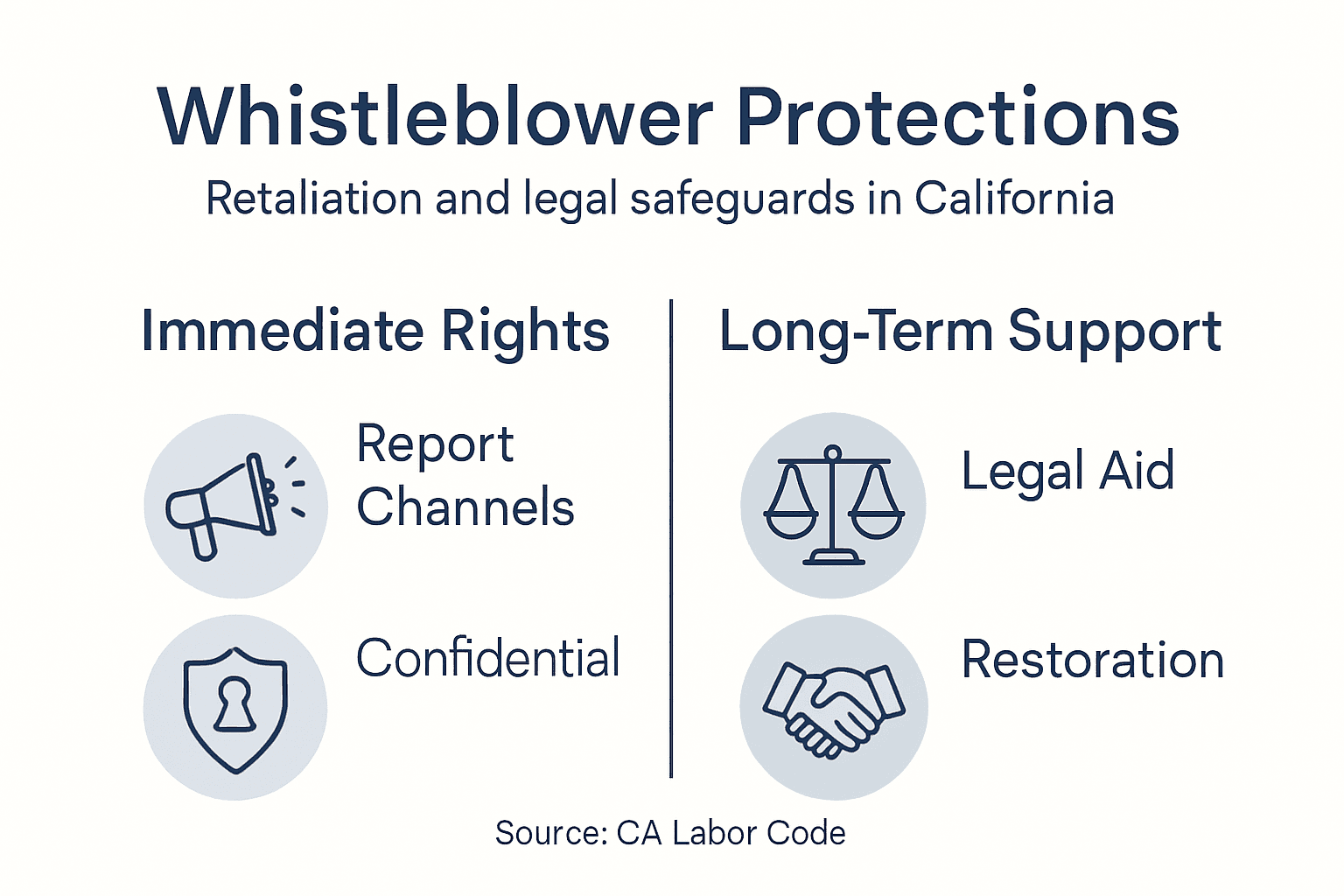
Moreover, the state’s commitment to worker protection goes beyond mere legal text. California mandates annual distribution of whistleblower protection information, maintains dedicated reporting hotlines, and provides multiple channels for employees to seek justice without compromising their professional standing.
The following table summarizes key legal protections offered to California whistleblowers:
| Legal Safeguard | Benefit to Employees | Applies to Public/Private Sector |
|---|---|---|
| Anonymous reporting allowed | Protects identity during complaints | Both |
| Guaranteed confidentiality | Safeguards sensitive information | Both |
| Right to reinstatement | Ensures return after wrongful firing | Both |
| Monetary compensation for damages | Offsets financial and emotional harm | Both |
| Protection against blacklisting | Preserves future employment options | Both |
Pro tip: Consult with an employment law specialist to understand the full scope of your whistleblower protections and develop a strategic reporting approach.
Recognizing and Documenting Workplace Retaliation
Workplace retaliation represents a complex legal challenge that requires meticulous documentation and strategic evidence collection. Employees in Yorba Linda must understand the nuanced ways employers might attempt to punish whistleblowers through subtle and overt actions.
The U.S. Department of Labor provides critical guidance on identifying workplace retaliation patterns, highlighting several key documentation strategies:
- Record precise dates of all interactions
- Save copies of emails and written communications
- Note changes in job responsibilities or work conditions
- Document performance evaluations before and after reporting
- Collect witness statements and contact information
- Maintain a chronological log of potentially retaliatory actions
- Screenshot digital communications when possible
- Preserve performance metrics and work assignments
Retaliatory actions can manifest through seemingly neutral workplace decisions that systematically undermine an employee’s professional standing. These might include unexpected performance reviews, sudden scheduling changes, or exclusion from key professional opportunities.

The Equal Employment Opportunity Commission emphasizes that successful retaliation claims require demonstrating a clear causal connection between protected activities and adverse employment actions. This means employees must build a comprehensive narrative that illustrates how their workplace experience changed after reporting misconduct.
Pro tip: Create a secure, password-protected digital folder to organize all documentation related to potential workplace retaliation.
Filing Complaints and Seeking Legal Remedies
Navigating the complex landscape of whistleblower complaints requires strategic planning and thorough understanding of available legal channels. Employees in Yorba Linda who have experienced workplace retaliation must be prepared to methodically document and pursue their rights through multiple potential avenues.
The Occupational Safety and Health Administration offers comprehensive complaint filing procedures for employees facing workplace retaliation:
- File online through official OSHA portals
- Submit complaints via mail, fax, or phone
- Provide detailed documentation of retaliatory actions
- Include specific dates and supporting evidence
- Identify witnesses and corroborating information
- Understand applicable statute of limitations
- Consider both federal and state-level complaint mechanisms
- Maintain copies of all submitted documentation
Legal remedies for whistleblowers can encompass multiple forms of compensation and professional restoration. These may include reinstatement to previous positions, recovery of lost wages, potential additional damages for emotional distress, and corrective actions against the offending employer.
Federal protections extend beyond immediate workplace interactions. The U.S. Office of Special Counsel provides independent investigation of prohibited personnel practices, offering employees robust channels for addressing workplace misconduct and potential retaliation.
Pro tip: Consult with an employment law specialist before filing a formal complaint to understand the most strategic approach for your specific situation.
Protect Yourself From Retaliation After Whistleblowing
Facing retaliation after reporting workplace misconduct is a serious challenge that no employee should endure. If you have experienced sudden demotion, exclusion from projects, or hostile treatment because you spoke up about unethical practices, you are not alone. Understanding your rights under whistleblower protection laws in California is critical to stopping harmful actions that damage your career and well-being.
At Serendib Law Firm, we specialize in defending employees against workplace retaliation. Our knowledgeable team is dedicated to guiding you through the complexities of whistleblower retaliation cases with personalized, zealous advocacy. Explore our Whistleblower Retaliation Archives to learn more about how we fight for employee rights in situations just like yours. For broader workplace disputes including retaliation, visit our Retaliation Archives and discover how we can help protect your future.
Don’t wait until the damage is done. Take control now by scheduling a free consultation with our experienced attorneys at Serendib Law Firm. Act today to stop retaliation and secure the legal support you deserve.
Frequently Asked Questions
What constitutes whistleblower retaliation?
Whistleblower retaliation refers to adverse actions taken against employees who report unethical or illegal practices in the workplace. This can include termination, demotion, pay reduction, and creating a hostile work environment.
How can employees document workplace retaliation?
Employees should maintain thorough records of all interactions related to their whistleblowing report. This includes keeping track of dates, saving emails, noting changes in responsibilities, documenting performance reviews, and gathering witness statements.
What legal protections are available for whistleblowers in California?
California provides several legal protections for whistleblowers, including anonymous reporting channels, confidentiality guarantees, protection from retaliatory actions, and potential compensation for damages if retaliated against.
What steps should an employee take if they experience retaliation after whistleblowing?
Employees should document the retaliatory actions, file a formal complaint through designated channels such as OSHA, and consider consulting with an employment law specialist to understand their rights and the best course of action.
Recommended
- Retaliation for Wage Theft Reports in Yorba Linda
- Whistleblowing Retaliation | Serendib Law Firm
- Whistleblower Protection | Serendib Law Firm
- Whistleblower Protection | Serendib Law Firm
https://www.serendiblaw.com/retaliation-whistleblowing-yorba-linda/?fsp_sid=499


Comments
Post a Comment